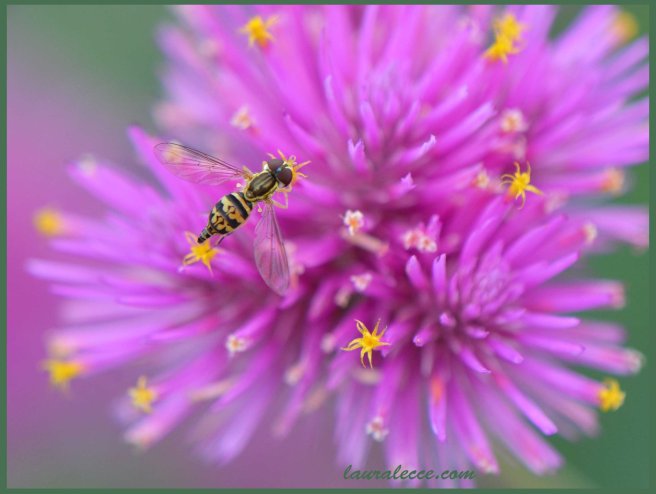
This weekend I met a magical hoverfly. Why magical? Because this is by far the most magical and festive photograph I have ever taken. As soon as I saw the result, I imagined this fly to be a character out of Alice in Wonderland. Those giant round eyes and delicate transparent wings are perfect compliments to the whimsical pattern of his yellow behind – hovering above a background of delicate pinks and greens, punctuated with bright yellow stars which complete this beautiful world. A snapshot of the most perfect moment in time and space.
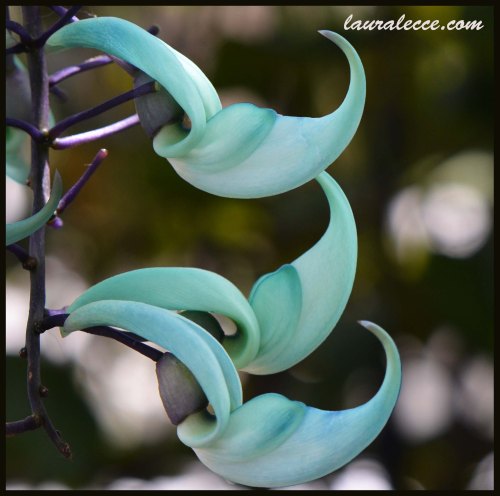
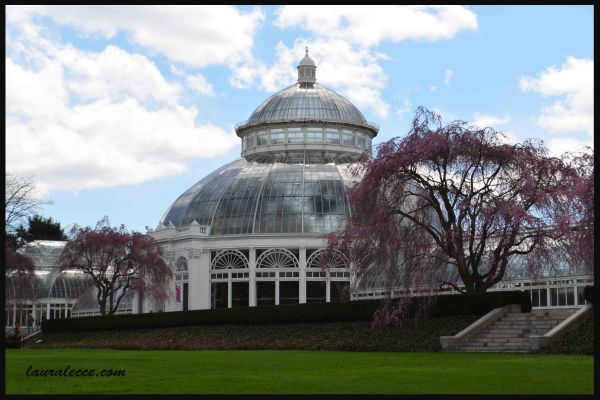
The Jade Vine (not to be confused with the jade plant also known as money tree) is an unusual plant native to the Philippines and is closely related to beans and peas. It grows into a monstrous vine with stems of up to 60 feet (18 meters) and once mature will hang hundreds of cascading flowers, dangling from stems as long as 10 feet (3 meters). These flowers range from a lovely turquoise color to a mint green. The flowers above were photographed from a mighty vine growing inside the Enid A. Haupt Conservatory (photo below) at the New York Botanical Gardens. It is a temperature controlled glass house that contains many tropical plants, which like myself, are most intolerant of New York winters. Happy weekend everyone!
New York Botanical Gardens – Photograph by Laura Lecce
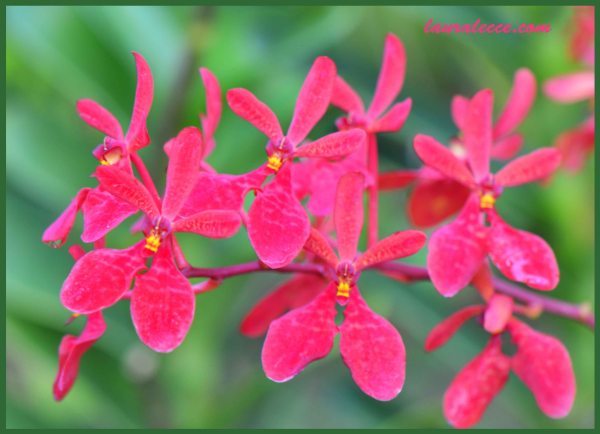
This is an orchid that I photographed while at the Singapore Botanic Gardens. A magnificent tropical garden which stretches as far as you can see. It was a bit of an effort walking around all day, on what was an incredibly hot day with 100% humidity. Though, as much as the people suffered in these stifling weather conditions, it is perfect for these orchids. They belong to a group of plants which are collectively called epiphytes, meaning that they love to grow harmlessly attached to another plant or tree with their roots free to absorb nutrients and moisture from the air and rain. These plants grow as a single, unbranching stem with leaves alternately growing on either side. They produce multiple branching flower stems with many flowers (pinkish-red, fiery red, orange or yellow) dancing on either side. Seeing a group of fully grown plants in flower is like looking at a brilliant firework display of heated colors exploding into the sky. Needless to say, this is one of my very favorite orchids.
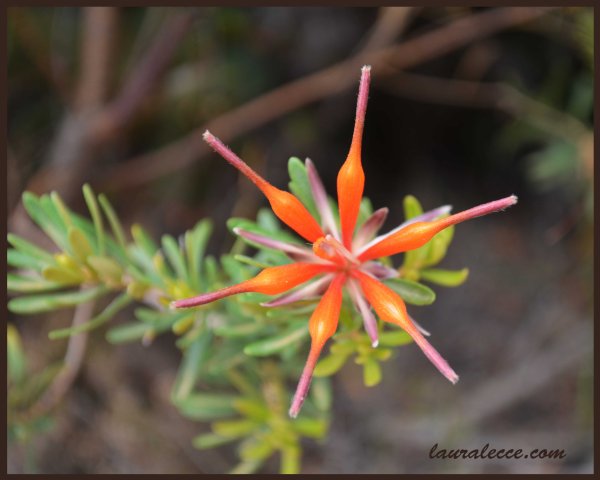
This flower is an unknown that I photographed in Tasmania. A little, orange, star-shaped flower on a small shrub in the Tassie grasslands. Even though I spent a very long time trawling through Google images under many search terms, the flower and the name remained elusive. I am surely not the only person to have photographed this little gem, so if anyone can shed some light on this flower, that would be very much appreciated. It is fitting that I introduce a star in a month where the talk of planets has been quite abundant. The five planets Mercury, Venus, Mars, Jupiter and Saturn have been visible this month in the night sky, together, shortly after sunset. I hope some of you have been out sky, star and planet gazing this month. Happy Friday everyone!
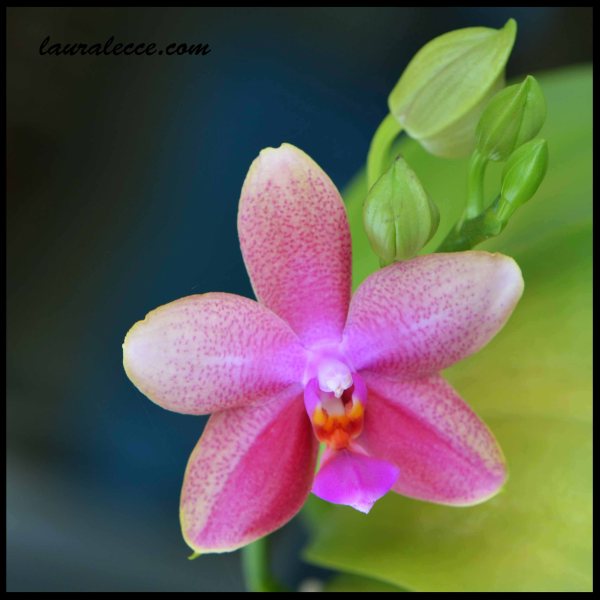
I think I’m starting to see a trend amongst my favorite flowers…. they’re mostly pink (I must be a girly girl after all, who knew?). This beautiful orchid is a phalaenopsis hybrid with a name I can no longer remember. I do however remember vividly the sweet aroma that this gorgeous flower produced every morning when it would see the sun. The fact that I remember the specific scents and not the names of most of my orchids is likely due to the fact that our sense of smell is the sense most closely linked with the memory areas of our brain. We thus associate those smells with specific memories and emotions. The scent of orchids reminds me of watering my plants in the morning sun while enjoying a cup of tea. Happy memories everyone!
Pink Water Lily Perfection – Photograph by Laura Lecce
Considering there are about 70 known species of water lily in five different genera, it’s easy to see how there is such a range of colors, shapes and sizes. This image was taken at the Nan Tien Temple, a Buddhist temple in Wollongong (80km south of Sydney). It is a very beautiful and tranquil place to visit, with lovely gardens and many water lilies silently floating in their ponds. Although both pink, this water lily is quite subtle and is very different to seemingly intense one that I have posted previously (click hereto see). Have a pretty pink weekend everyone!
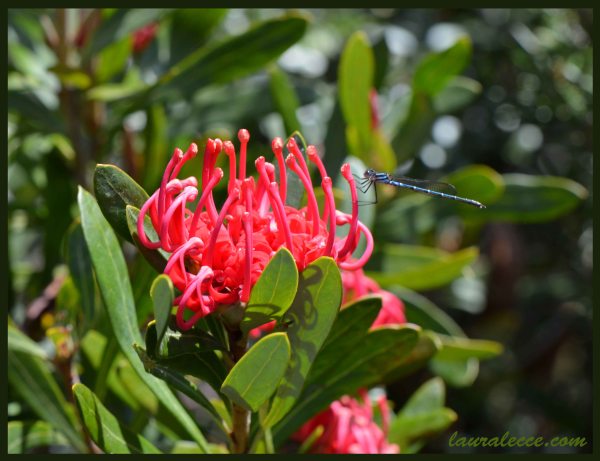
I don’t think many of us from mainland Australia would know that Tassie has its very own type of Waratah. The waratah is a very special flower to those of us from the state of New South Wales, as it is our state emblem. The Tasmanian variety is called Telopea truncata (seen in the photo above), which has different flowers to Telopea speciosissima that we are used to seeing. Through pure chance, this photo also includes a damselfly which might be one of three different types (apparently commonly mistaken) called Austrolestes annulosus (the blue ringtail), Coenagrion lyelli, or Caliagrion billinghursti. After looking through many photos of them on Google, I am most definitely not taking the chance at picking which one! Sometimes we are better off not knowing and just enjoying, have a great weekend everyone!
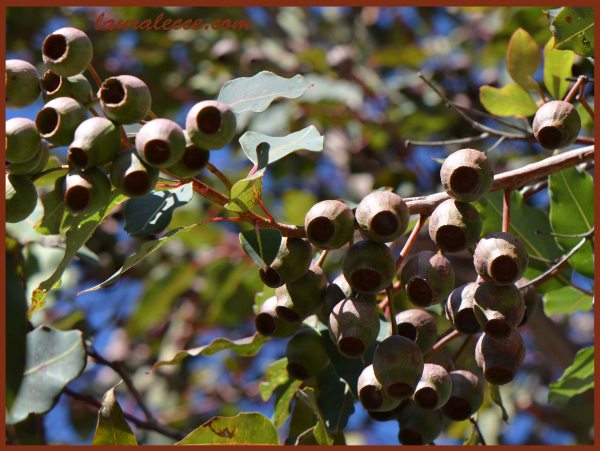
Dried gumnuts are commonly used as ornamental decorations in Australia, as they come in a huge variety of different shapes and sizes. They were made famous when Australian writer and illustrator May Gibbs (who was born in England) wrote about two adorable gumnut babies, Snugglepot and Cuddlepie as the main characters of her books. The eucalyptus trees which produce these gumnuts inhabit forests which are incredibly flammable. They constantly drop dry leaves and peeled bark onto the floor around them, and together with the eucalyptus oil within, can quickly turn a small fire into a fast moving and raging inferno. Every summer Australia battles bushfires to some degree, but however devastating these fires are for the animals and people living in those areas, the trees are actually adapted to be the most successful survivors. The release of seeds from the gumnuts are triggered by fire, and they fall onto the nutrient-rich ash covered ground, free from competing plants and damaging insects. They will quickly repopulate the forests, and continue to be the dominating species of the Aussie bush. Happy weekend everyone!
Click here to see my other post on Eucalyptus Flowers.
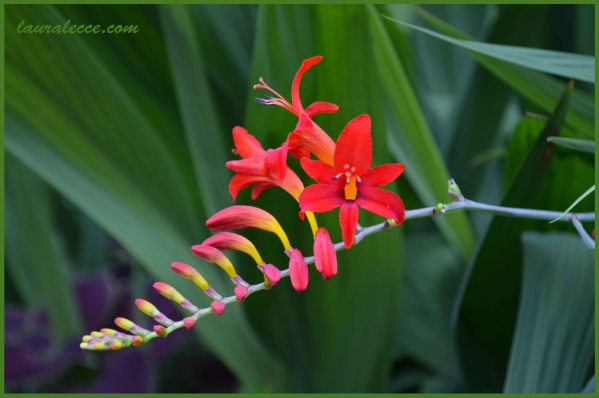
Every day on my way to and from work I pass through a beautifully maintained courtyard garden which is always alive with color. Commonly in Manhattan, garden beds get replanted every few months with plants that reflect the current season (unlike Sydney which is temperate enough to keep most plants all year round, or a summer/winter change of annuals). New York summer brings high heat and humidity, and a fitting reflection of that is this fiery red flower belonging to Crocosmia ‘Lucifer’. The flowers catch my eye every day due to the contrast of the intense red against a background of large, deep green leaves. This plant, along with many others, is now bookmarked in my head as a “must have” in my currently imaginary, beautifully tranquil, future garden of my own. Happy weekend everyone!!!
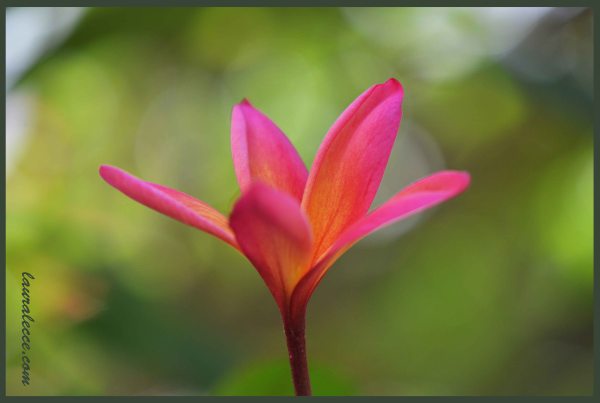
The frangipani (Plumeria) is a beautiful plant with gorgeous flowers that come in varieties of whites, yellow, oranges and pinks. Although native to Central and South America, they are a popular plant that can now be found in most tropical places around the world. This plant however, is not without its quirks, being related to Oleander, both produce an irritating sap similar to Euphorbia plants (click here to see my post on Euphorbia). Frangipanis are also fragrant, most heavily at night, to attract the sphinx moth under the false pretense that the flowers contain a sweet smelling nectar. As the moth goes from flower to flower in search of the non-existent nectar, it is in fact being duped into pollinating the flowers. Cheeky frangipanis…. Have a great weekend everyone!

 Laura Lecce's art and photography