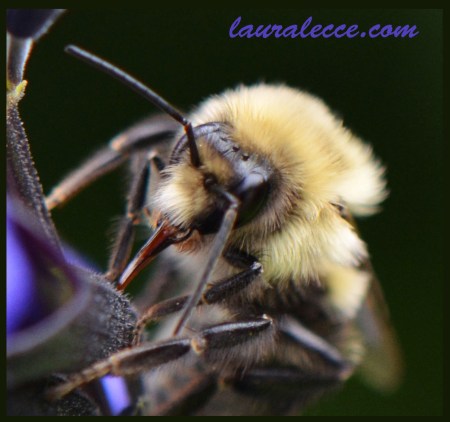
To bee or not to bee

To bee or not to bee – Photograph by Laura Lecce

Recently there have been two scientific studies which have highlighted how smart bees really are at learning. One of these studies trained bees to pull on a string which gave them access to a sucrose treat. The second study wanted to see if bees could perform a very unnatural task that required manipulation of a tool to get a reward. The bees were shown that the proper location of a yellow ball was inside a drawn circle. The bee then had to figure out how to relocate a misplaced ball back into the circle to gain a reward. Once the bee had learned these tasks they improved significantly each time, taking less time to complete the task. Not only did bees learn these tasks, other bees which were placed as observers could then complete the task themselves on the first try, hence learning the skill from watching a trained bee. This learning could be transferred through many successions of new trainers and new observers. These studies show that bees can learn new and complex tasks which were previously thought to be unique to vertebrates such as mammals and birds and also transfer those skills throughout their colony which may help them adapt in the presence of changing evolutionary pressures (click here to see a video highlighting these studies).

You are what you eat

Pink Flamingo – Photograph by Laura Lecce

Flamingoes are one example of how ‘what you eat’ can be reflected in your appearance. We associate flamingoes with the color pink or orange when in fact they are born a dull greyish color. The lakes and wetlands they live in are breeding grounds for algae, shrimp and mollusks – tasty munchies that these beautiful birds spend their days consuming. Each of these tasty treats are loaded with beta-carotene, an organic chemical which is a reddish-orange color and is famously known for making carrots orange. Beta-carotene gives shrimp their orange color when cooked, and shrimp-eating salmon their pink flesh. This chemical is an important one which gets converted into vitamin A in our bodies and contributes to healthy skin, teeth, bones and good vision. Interestingly, farmed salmon and zoo flamingoes which are not necessarily fed a ‘wild’ diet are made pink by the addition of canthaxanthin to their food, yet another naturally occurring carotenoid which is well known to give Chanterelle mushrooms their yellow/orange coloration.

Bark-mimicking grasshopper

Bark-mimicking Grasshopper – Photograph by Laura Lecce

This sizable insect is commonly known as a bark-mimicking grasshopper (Coryphistes ruricola) and even its eyes look like they are actually made of wood. They are common in Australia and depending on location and surrounding environment, appear in various colors from grays to browns. Collectively they are an interesting view of natural selection at work. This grasshopper which was photographed in Western Australia was in an area where there weren’t many trees at all, but blended in very well with the sand it was sitting on. If I was a bird I would certainly think twice about whether I was about to eat a grasshopper or a piece of fallen tree branch.

For other insects please click here.

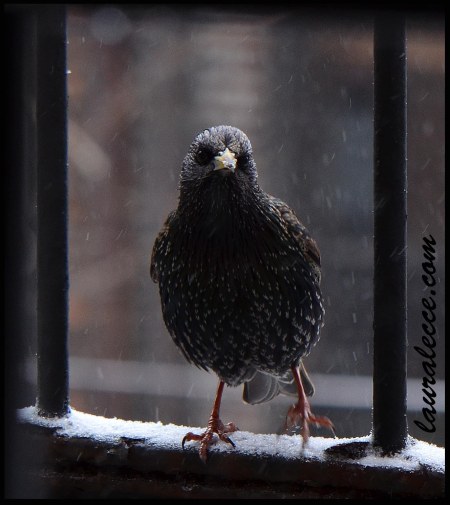
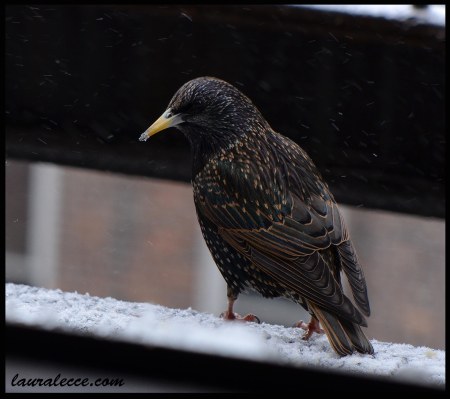
Starling in a Snowstorm

Starling in a Snowstorm – Photograph by Laura Lecce

Storms are hard on everyone, but none more so than the poor birds which have very little shelter from the wind and cold. I saw a photo today of a very defeated cockatoo in Australia sitting amongst fallen branches, wet and with most of his feathers blown off by cyclone Debbie. Thankfully he was rescued by the photographer and I hope he will make a speedy recovery. The bird in these photos was weathering out a snowstorm in New York two weeks ago (hopefully our last one of the winter) and was grateful that I provided some breadcrumbs. Actually in truth I am not sure that the bird was grateful because grumpy is its permanent facial expression. I cannot blame him as I’d be grumpy too if I was locked outside in a snowstorm with no socks to keep my feet warm.

Grateful but naturally grumpy – Photograph by Laura Lecce

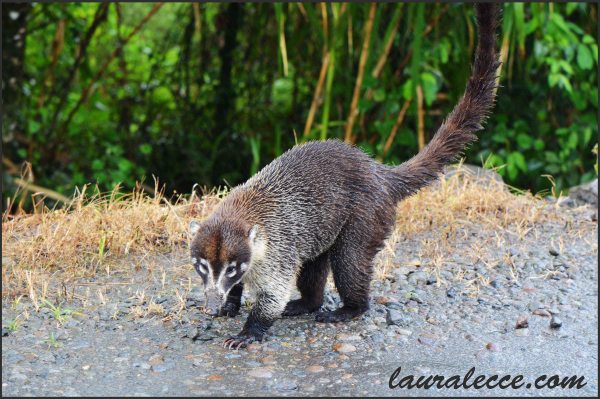
Peculiar Pizote

Peculiar Pizote – Photograph by Laura Lecce

There are so many animals that I meet on my travels that I didn’t know existed. This pizote was one such animal that I had never heard of until I met this gorgeous creature in Costa Rica. It is also known as a coati and belongs to the same family as raccoons. They are omnivores with a diet of insects, small vertebrates and fruits. Like raccoons they will scavenge through the trash to find something to eat and seem to be quite used to human encounters. They are quite intelligent and have even been kept as domestic pets. This particular pizote seems to have learned that approaching the side of a car may result in being fed, however, on this particularly rainy day he was out of luck.

For other Costa Rican animals please click here.

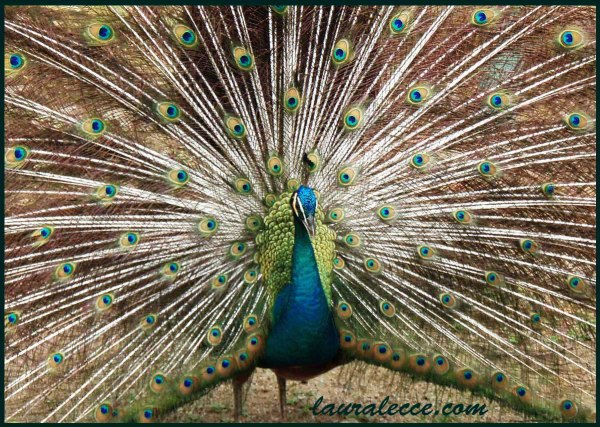
Showmanship is everything

The proudest peacock – Photograph by Laura Lecce

I had never really imagined what it would be like to meet a peacock, perhaps because I never thought I would ever actually meet one. However this beautiful male was strutting his stuff in a park in Malaysia and putting on the performance of a lifetime for anyone who was interested in watching. They are a fairly large bird, perhaps the size of a turkey, but with over 200 tail feathers extended they are about 6 feet (2 meters) wide. In the world of birds there is certainly a lot of pressure placed on males to outperform competing males with brighter colors, more feathers, and complex mating dances. Female peahens will prefer a male with  larger sized and greater number of eye spots, as this will likely result in larger and fitter peachicks. One stunning male will have a harem of rather plain looking females and will play no role in raising the young. This is probably for the best as it helps the well camouflaged females raise their young by safely blending in with the scenery.

For other bird posts please click here.

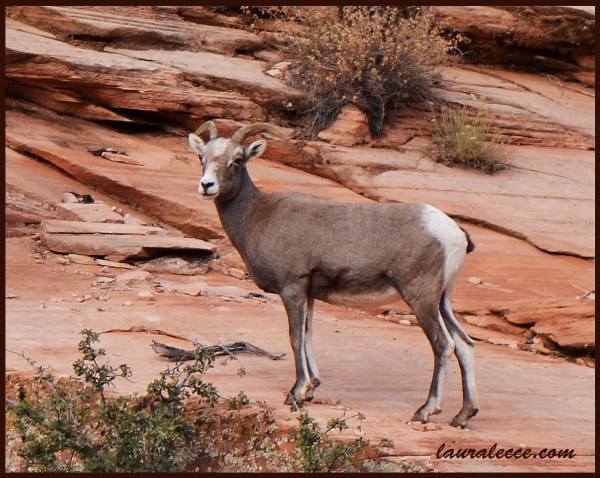
Bighorn Sheep (which looks more like a goat to me)

Bighorn Sheep - Photograph by Laura Lecce
Bighorn Sheep – Photograph by Laura Lecce

This dainty female bighorn sheep lives in Zion National Park in Utah. Zion has the perfect landscape for these sure-footed animals which gracefully hop around on very treacherous-looking cliff faces with incredible ease. They can navigate these terrains even as little lambs because pregnant mothers seek higher ground to give birth which is safer from predators. However, the areas that are safer from predators are less favorable for growing sufficient vegetation, so as soon as the lambs are agile on their feet they will follow their mother back down the cliff faces to find food. These animals are native to North America and their numbers suffered greatly with the introduction of domestic sheep which carry pathogens that are easily spread to wild populations. To me these bighorn sheep look more like goats and equally amusing to me, the white and fluffy mountain goats look more like sheep.  Zion has a herd of over 400 sheep and is a great location to see these gorgeous creatures which are most often spotted between the tunnel and east entrance to the park.

For other posts about Zion National Park please click here.

Bat in a bind

Bat in a bind - Photograph by Laura Lecce
Bat in a bind – Photograph by Laura Lecce

This is an Australian flying fox hanging on my parents garden fence. Australia has a few different species of flying fox, some of which are among the largest bats in the world. Some people may be horrified by this devilish-looking vampire-like creature, but actually they have a very cute face. They are fruit, flower and nectar eaters by night and by day they are busy sleeping (when they are not screeching at neighbors for space on overpopulated tree houses). They live in huge family groups which can have thousands of bats. Unlike most bats they do not use echolocation as they have great vision and are known to use geographical landmarks to find their way home. How did this bat end up in my parents yard in broad daylight? Well, my dad had realized that his figs were getting eaten (usually it’s the birds that get to them). So he covered the fig trees with netting to stop the birds from accessing the fruit. My mum awoke the next morning to find an angry bat tangled in the netting which had been trying to get to the fruit, and a very curious cat on the fence keeping a close eye on this mysterious find. She called my brother to get some scissors to cut the bat out of the netting, which he did, all the while trying not to get bitten by this agitated critter. After being freed from the net the exhausted bat hung on the fence a while to find the energy to fly away home. (Photo is courtesy of my mum.)

Black currawong and her honey bush

Black currawong and her honey bush - Photograph by Laura Lecce
Black currawong and her honey bush – Photograph by Laura Lecce

This intense-looking bird is a black currowong native to Australasia that I photographed while hiking in Tasmania. These birds look quite similar to Australian magpies except that their eye color is yellow instead of red. They have a very special relationship with the richea honey bush and were featured in a David Attenborough narrated documentary called Life in the episode on plants. The honey bush encases its flowers in individual little pods which protect the flowers from cold weather and icy winds that are common in Tasmania. Unfortunately it also prevents successful pollination of the flowers by insects which cannot access them nor remove the protective outer casing. When warmer weather comes along the flowers produce a nectar which attracts the currawongs. They go about their day pulling off each of the little flower pods to access the nectar which also exposes the flowers to pollinating insects and thus the plant can reproduce.

For other posts from Tasmania please click here, or for birds please click here.

Angry Caracara

Angry Caracara
Angry Caracara – Photograph by Laura Lecce

This is an angry looking bird if ever I saw one! It is a caracara, which is a bird of prey belonging to the same family as falcons. Unlike falcons which are fast flying and skilled aerial hunters, these are the slower and lazier cousins which prefer to scavenge for prey that is already injured or dead. I’m pretty sure this is a northern caracara which has a less defined, patchy barring across the chest. The skin on their face ranges from yellow to deep red/pink depending on the age of the bird. This one was photographed in the Washington Slagbaai National Park in Bonaire, and as you can see he was not too happy about the photo.

For other posts on birds please click here.