The eagle and the bird who hates him

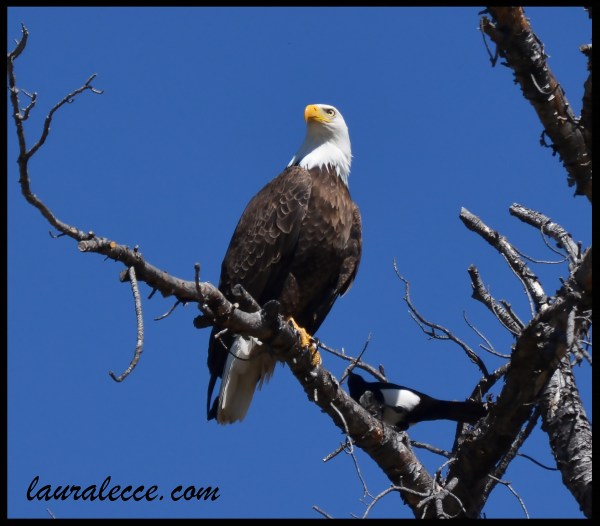
The eagle and the bird who hates him – Photograph by Laura Lecce

It’s tough to be so loved and admired, to be an American icon and a symbol of great strength. Lucky for this eagle, his ego will be a little smaller because of a little bird (well little sitting next to this eagle) who absolutely despises him! As I was in absolute awe that I got lucky enough to get up close and photograph this stunning bird, the bird next to him was determined to shoo him away. At one point the little bird was hanging off his tail feathers trying to yank them out with his beak and flapping around the poor eagle’s head and making a hell of a racket. I guess having a large and cunning predator so close to home must be a bit distressing. It was also spring time in Yellowstone National Park, which probably meant chicks in a nest that need protecting. Lucky for the little bird that the eagle didn’t seem on the hunt for lunch. Also lucky for me and my camera that the eagle didn’t seem at all surprised or phased to have this annoying bird bothering him, and just sat his ground looking as regal as ever. What a fantastic experience!

For other pics and posts from Yellowstone National Park – please click here.
I met a marmot

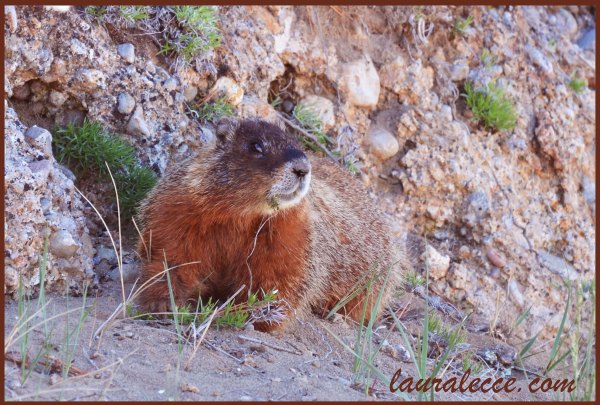
The marmot I met – Photograph by Laura Lecce

I met a marmot for the first time in Yellowstone National Park, and these little critters are now quite possibly at the top of my favorites list (well second,  lizards still win). They are such a cute, cuddly-looking, round ball of orange-brown fur. In the case of the photo above, the fur color was a perfect blend with the rock that this marmot calls his home. Never straying far from the safety of his fortress, he went on happily munching the grass shoots in his front yard while I sat and took his photo. It took a while for me to get a good portrait as he mostly had his head down pulling up grass, then would periodically put his head up for a just a second to check that I was still watching him. Capturing a photo of a marmot is a very seasonal activity, as you wont find them around from about September to May as they happily hibernate through the colder months of the year. I wish I could do the same!

The yellow eyebrows of a blue grouse

Blue Grouse – Photograph by Laura Lecce

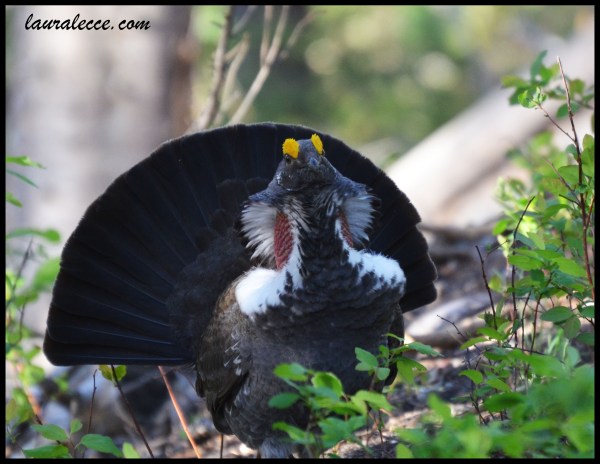
This is a gloriously proud male grouse who had decided I was infringing upon his territory. To let me know this he performed his intimidation dance – tail feathers sprawled, neck feathers on end to uncover that red wrinkly skin, and an angry frown with his bright yellow eyebrows. Little did he know, that instead of scaring me away, his dance was what got him noticed in the first place. After taking his photo, I let him think he won and scared me off with his territorial display. Such a gorgeous and unusual bird!

Good at spotting balls of fluff (commonly known as raccoons)

Ball of fluff – Photograph by Laura Lecce

Isn’t this the cutest face you’ve ever seen?!

I always keep an eye out for raccoons whenever I am walking through Central Park in New York. I have become very adept in spotting them after I learned a few simple things. They are mostly in the trees and not on the ground. I had no idea that raccoons slept in trees, so look for round bundles of fur tucked into the fork of trees where the large branches leave the trunk. The hour before sunset is when these little fuzz balls are waking up and they start moving which makes them easier to see. You will find them stretching, grooming and coming down from the trees to rummage through the parks trash cans. This little youngster was quite unsure of me and so had all of its fur on end – clearly a grumpy morning person (or evening raccoon).

Nothing’s greener than a tree frog

Nothing’s greener than a tree frog – Photograph by Laura Lecce

These green tree frogs are the masters of camouflage. They look exactly the same color and shape as new mangrove leaves, which is exactly how I would want to look too if I lived in croc infested waters in Cairns, Australia. They’re actually quite chubby and large for a frog, growing to about 4.5 inches long (11.5 cm). They are a wonderful visitor to have in your garden if you are so lucky, as they eat cockroaches, locusts, moths and spiders. They are docile creatures who are relatively unafraid of humans, and so are commonly found hanging around outdoor lights waiting for approaching food. They are incredibly vocal using calls for mating, but will also scream when attacked by predators or squeak when poked. As cute as that may be, I do not encourage you to go around poking tree frogs as any toxins on your hand will get absorbed through their skin which is also how they absorb oxygen to breathe.

For other frog posts please click here.

To bee or not to bee

To bee or not to bee – Photograph by Laura Lecce

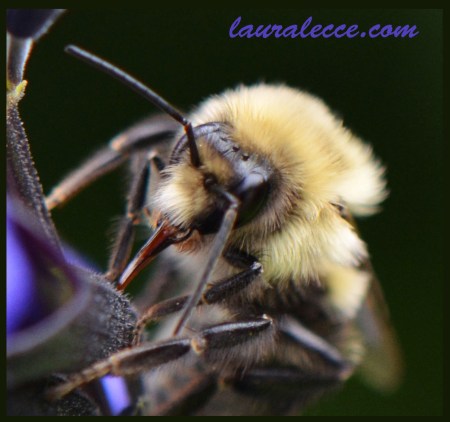
Recently there have been two scientific studies which have highlighted how smart bees really are at learning. One of these studies trained bees to pull on a string which gave them access to a sucrose treat. The second study wanted to see if bees could perform a very unnatural task that required manipulation of a tool to get a reward. The bees were shown that the proper location of a yellow ball was inside a drawn circle. The bee then had to figure out how to relocate a misplaced ball back into the circle to gain a reward. Once the bee had learned these tasks they improved significantly each time, taking less time to complete the task. Not only did bees learn these tasks, other bees which were placed as observers could then complete the task themselves on the first try, hence learning the skill from watching a trained bee. This learning could be transferred through many successions of new trainers and new observers. These studies show that bees can learn new and complex tasks which were previously thought to be unique to vertebrates such as mammals and birds and also transfer those skills throughout their colony which may help them adapt in the presence of changing evolutionary pressures (click here to see a video highlighting these studies).

You are what you eat

Pink Flamingo – Photograph by Laura Lecce

Flamingoes are one example of how ‘what you eat’ can be reflected in your appearance. We associate flamingoes with the color pink or orange when in fact they are born a dull greyish color. The lakes and wetlands they live in are breeding grounds for algae, shrimp and mollusks – tasty munchies that these beautiful birds spend their days consuming. Each of these tasty treats are loaded with beta-carotene, an organic chemical which is a reddish-orange color and is famously known for making carrots orange. Beta-carotene gives shrimp their orange color when cooked, and shrimp-eating salmon their pink flesh. This chemical is an important one which gets converted into vitamin A in our bodies and contributes to healthy skin, teeth, bones and good vision. Interestingly, farmed salmon and zoo flamingoes which are not necessarily fed a ‘wild’ diet are made pink by the addition of canthaxanthin to their food, yet another naturally occurring carotenoid which is well known to give Chanterelle mushrooms their yellow/orange coloration.

Starling in a Snowstorm

Starling in a Snowstorm – Photograph by Laura Lecce

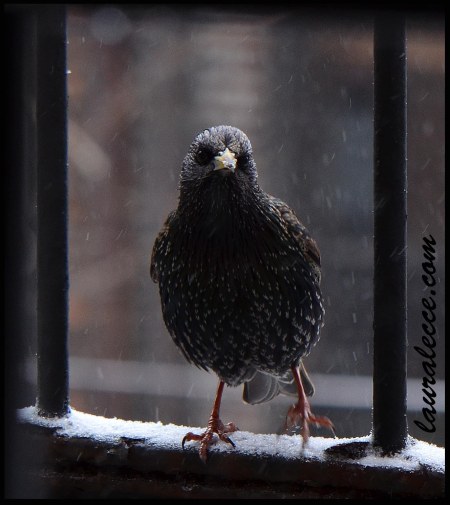
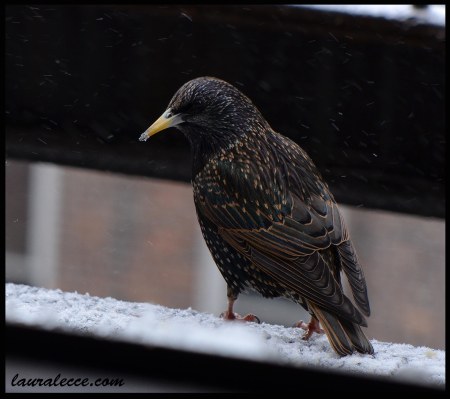
Storms are hard on everyone, but none more so than the poor birds which have very little shelter from the wind and cold. I saw a photo today of a very defeated cockatoo in Australia sitting amongst fallen branches, wet and with most of his feathers blown off by cyclone Debbie. Thankfully he was rescued by the photographer and I hope he will make a speedy recovery. The bird in these photos was weathering out a snowstorm in New York two weeks ago (hopefully our last one of the winter) and was grateful that I provided some breadcrumbs. Actually in truth I am not sure that the bird was grateful because grumpy is its permanent facial expression. I cannot blame him as I’d be grumpy too if I was locked outside in a snowstorm with no socks to keep my feet warm.

Grateful but naturally grumpy – Photograph by Laura Lecce

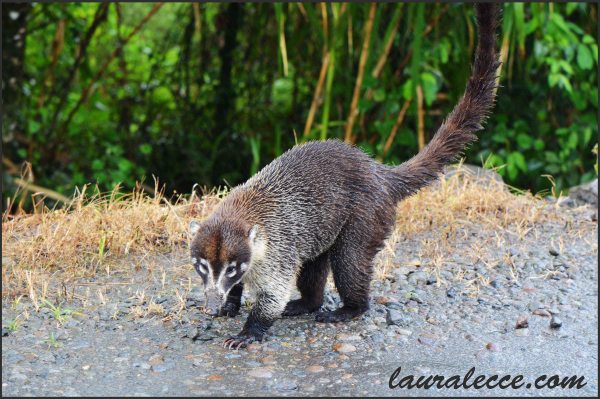
Peculiar Pizote

Peculiar Pizote – Photograph by Laura Lecce

There are so many animals that I meet on my travels that I didn’t know existed. This pizote was one such animal that I had never heard of until I met this gorgeous creature in Costa Rica. It is also known as a coati and belongs to the same family as raccoons. They are omnivores with a diet of insects, small vertebrates and fruits. Like raccoons they will scavenge through the trash to find something to eat and seem to be quite used to human encounters. They are quite intelligent and have even been kept as domestic pets. This particular pizote seems to have learned that approaching the side of a car may result in being fed, however, on this particularly rainy day he was out of luck.

For other Costa Rican animals please click here.

Showmanship is everything

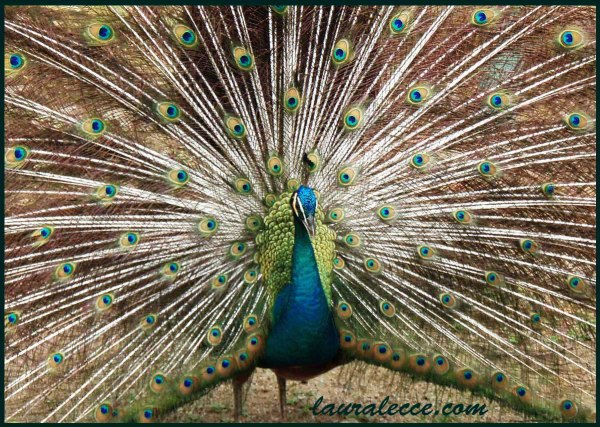
The proudest peacock – Photograph by Laura Lecce

I had never really imagined what it would be like to meet a peacock, perhaps because I never thought I would ever actually meet one. However this beautiful male was strutting his stuff in a park in Malaysia and putting on the performance of a lifetime for anyone who was interested in watching. They are a fairly large bird, perhaps the size of a turkey, but with over 200 tail feathers extended they are about 6 feet (2 meters) wide. In the world of birds there is certainly a lot of pressure placed on males to outperform competing males with brighter colors, more feathers, and complex mating dances. Female peahens will prefer a male with  larger sized and greater number of eye spots, as this will likely result in larger and fitter peachicks. One stunning male will have a harem of rather plain looking females and will play no role in raising the young. This is probably for the best as it helps the well camouflaged females raise their young by safely blending in with the scenery.

For other bird posts please click here.