To bee or not to bee

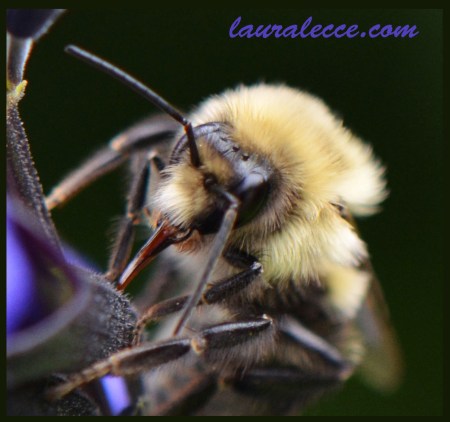
To bee or not to bee – Photograph by Laura Lecce

Recently there have been two scientific studies which have highlighted how smart bees really are at learning. One of these studies trained bees to pull on a string which gave them access to a sucrose treat. The second study wanted to see if bees could perform a very unnatural task that required manipulation of a tool to get a reward. The bees were shown that the proper location of a yellow ball was inside a drawn circle. The bee then had to figure out how to relocate a misplaced ball back into the circle to gain a reward. Once the bee had learned these tasks they improved significantly each time, taking less time to complete the task. Not only did bees learn these tasks, other bees which were placed as observers could then complete the task themselves on the first try, hence learning the skill from watching a trained bee. This learning could be transferred through many successions of new trainers and new observers. These studies show that bees can learn new and complex tasks which were previously thought to be unique to vertebrates such as mammals and birds and also transfer those skills throughout their colony which may help them adapt in the presence of changing evolutionary pressures (click here to see a video highlighting these studies).
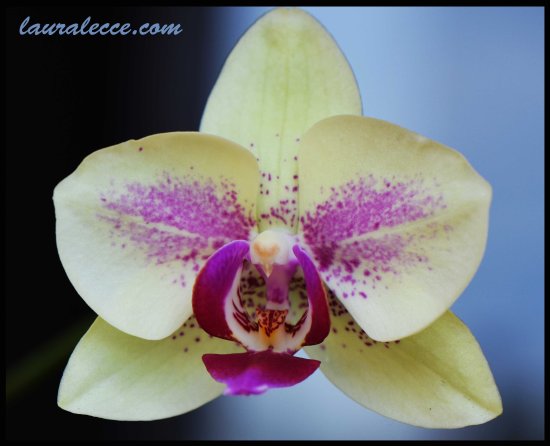
Friday Flower – Sweet Little Phal

Sweet natured phalaenopsis – Photograph by Laura Lecce

Todays flower is an adorable little phalaenopsis with a very sweet personality. I know that flowers cannot have personalities, but I love to imagine what they would be like if they did. This orchid would be skipping around in a yellow flowing dress with pink streamers flying from her curly hair, a huge cheeky smile on her face and an infectious laughter which brightens up the day of everyone she meets. I hope she brightens up your Friday, happy weekend everyone!

For other orchid posts please click here.

You are what you eat

Pink Flamingo – Photograph by Laura Lecce

Flamingoes are one example of how ‘what you eat’ can be reflected in your appearance. We associate flamingoes with the color pink or orange when in fact they are born a dull greyish color. The lakes and wetlands they live in are breeding grounds for algae, shrimp and mollusks – tasty munchies that these beautiful birds spend their days consuming. Each of these tasty treats are loaded with beta-carotene, an organic chemical which is a reddish-orange color and is famously known for making carrots orange. Beta-carotene gives shrimp their orange color when cooked, and shrimp-eating salmon their pink flesh. This chemical is an important one which gets converted into vitamin A in our bodies and contributes to healthy skin, teeth, bones and good vision. Interestingly, farmed salmon and zoo flamingoes which are not necessarily fed a ‘wild’ diet are made pink by the addition of canthaxanthin to their food, yet another naturally occurring carotenoid which is well known to give Chanterelle mushrooms their yellow/orange coloration.

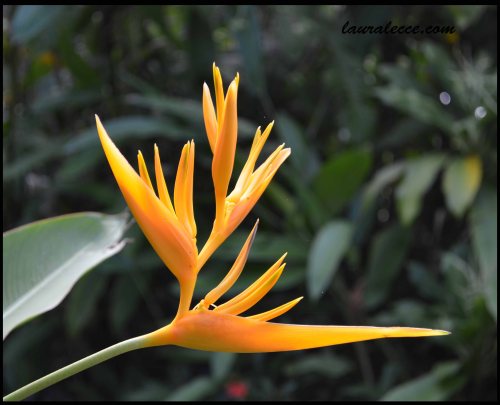
Yellow Heliconia

Yellow Heliconia – Photograph by Laura Lecce

These beautiful plants are known for a range of colored flowers predominantly seen in red, orange and yellow. They are mostly a tropical plant and are unsurprisingly related to the Bird of Paradise (of which the flowers look very similar) and also bananas (which look like a larger version of this plant). The flower produces nectar to attract pollinators such as hummingbirds. If you ever decide you want a tropical-looking garden, the inclusion of some different heliconias are a must and fairly easy to grow. The luscious green foliage and bright splash of flower color will certainly brighten up your day. Happy weekend everyone!

Bark-mimicking grasshopper

Bark-mimicking Grasshopper – Photograph by Laura Lecce

This sizable insect is commonly known as a bark-mimicking grasshopper (Coryphistes ruricola) and even its eyes look like they are actually made of wood. They are common in Australia and depending on location and surrounding environment, appear in various colors from grays to browns. Collectively they are an interesting view of natural selection at work. This grasshopper which was photographed in Western Australia was in an area where there weren’t many trees at all, but blended in very well with the sand it was sitting on. If I was a bird I would certainly think twice about whether I was about to eat a grasshopper or a piece of fallen tree branch.

For other insects please click here.

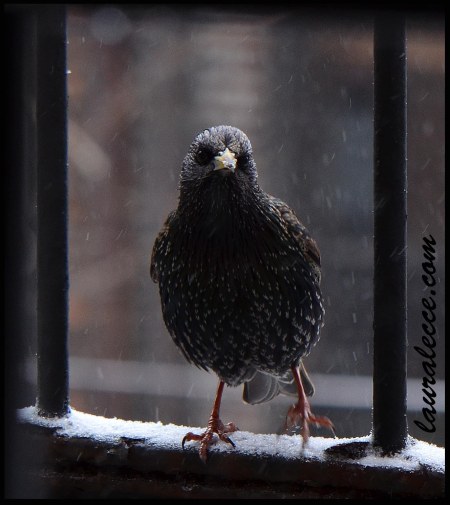
Starling in a Snowstorm

Starling in a Snowstorm – Photograph by Laura Lecce

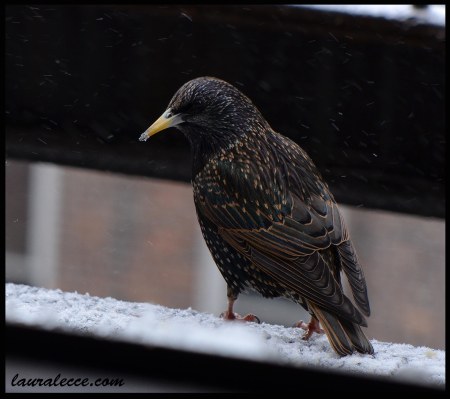
Storms are hard on everyone, but none more so than the poor birds which have very little shelter from the wind and cold. I saw a photo today of a very defeated cockatoo in Australia sitting amongst fallen branches, wet and with most of his feathers blown off by cyclone Debbie. Thankfully he was rescued by the photographer and I hope he will make a speedy recovery. The bird in these photos was weathering out a snowstorm in New York two weeks ago (hopefully our last one of the winter) and was grateful that I provided some breadcrumbs. Actually in truth I am not sure that the bird was grateful because grumpy is its permanent facial expression. I cannot blame him as I’d be grumpy too if I was locked outside in a snowstorm with no socks to keep my feet warm.

Grateful but naturally grumpy – Photograph by Laura Lecce

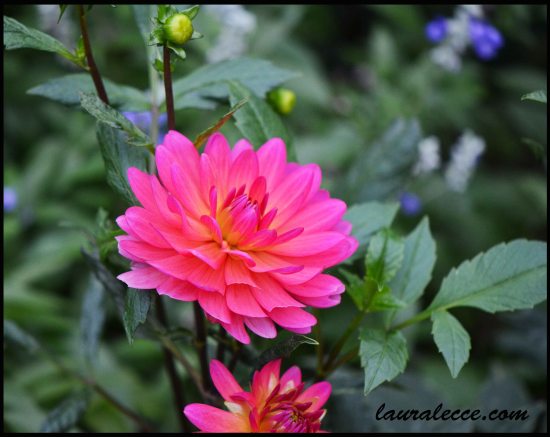
Friday Flower – Electric pink dahlia

Electric Pink Dahlia – Photograph by Laura Lecce

I think it’s about time for another dahlia. The huge variety in these flowers ensures that they always get my attention. This stunning pink flower is made even more impressive against the dark green leaves of the plant. The layers of petals are carefully arranged to expose just a hint of deep yellow in the center of the flower. With every day, new petals are developing and the flower continues a seductive undress for all the insects that want to access the precious pollen at the heart of this magnificent flower. Happy weekend everyone!!!

For other dahlia posts please click here.

Peculiar Pizote

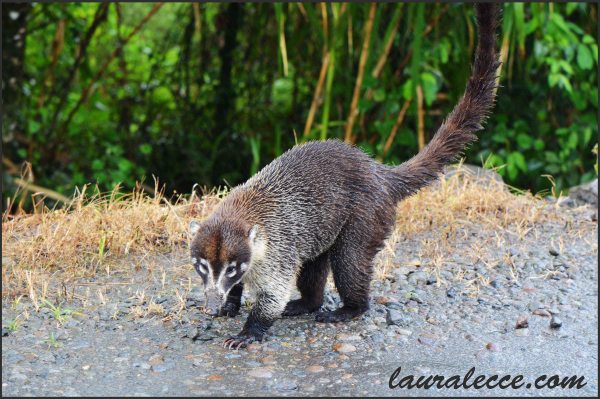
Peculiar Pizote – Photograph by Laura Lecce

There are so many animals that I meet on my travels that I didn’t know existed. This pizote was one such animal that I had never heard of until I met this gorgeous creature in Costa Rica. It is also known as a coati and belongs to the same family as raccoons. They are omnivores with a diet of insects, small vertebrates and fruits. Like raccoons they will scavenge through the trash to find something to eat and seem to be quite used to human encounters. They are quite intelligent and have even been kept as domestic pets. This particular pizote seems to have learned that approaching the side of a car may result in being fed, however, on this particularly rainy day he was out of luck.

For other Costa Rican animals please click here.

Friday Flower – Brassia orchid

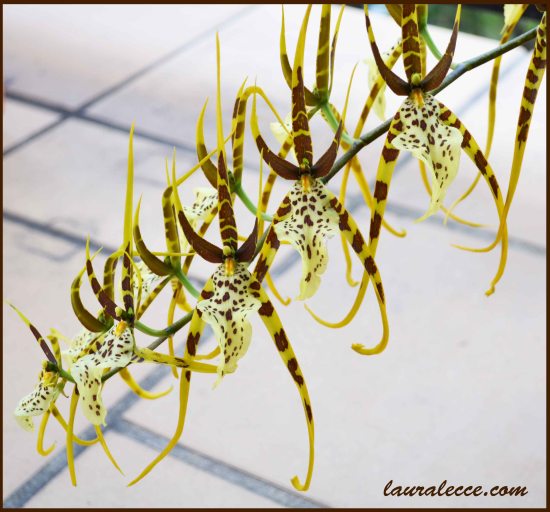
Brassia orchid – Photograph by Laura Lecce

This beautiful Brassia orchid is one of my favorites because it possess so much character. Every Spring it sends out a long flower spike with numerous colorful and fragrant flowers each with their very own unique and bold pattern (if you look close enough you will see that every splash of brown is a slightly different shape). These orchids which are mostly native to Mexico and Central America are also called spider orchids because their long thin petals resemble spider legs. If you need to be convinced – click here for my post on the St Andrews Cross spider. Have a happy weekend everyone!!!

Friday Flower – Jelly bean succulent

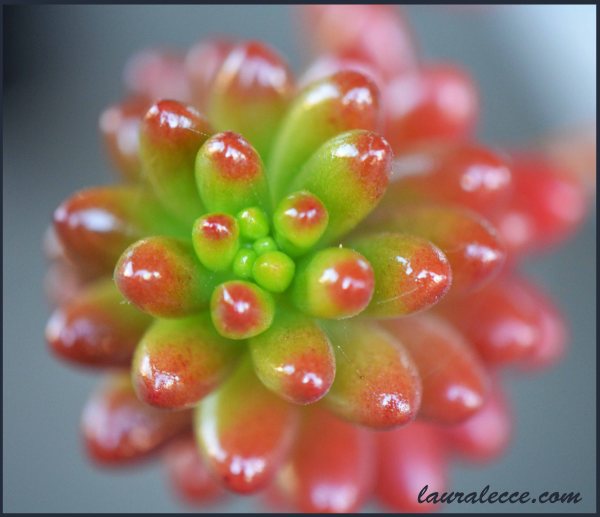
Jelly bean succulent – Photograph by Laura Lecce

Succulent sedum rubrotinctum is native to Mexico and a very lovely addition to any succulent garden. It displays lovely green jelly beans along each branch for most of the year except in summer to early spring when it gets a bit more sun it will blush a delicate red. Like most succulents, each individual segment (or bean) can fall off (or be picked off) and will grow roots and a brand new succulent when it touches the soil. The branches of this succulent grow upwards towards the sun and when they become long and heavy enough they will cascade over the side of a pot. For some creative succulent photography (and provided you don’t mind sacrificing your succulent for the sake of a photo) I sprayed this succulent branch with hairspray first to give it a lovely glossy shine. Happy weekend everyone!

For other succulent posts please click here.