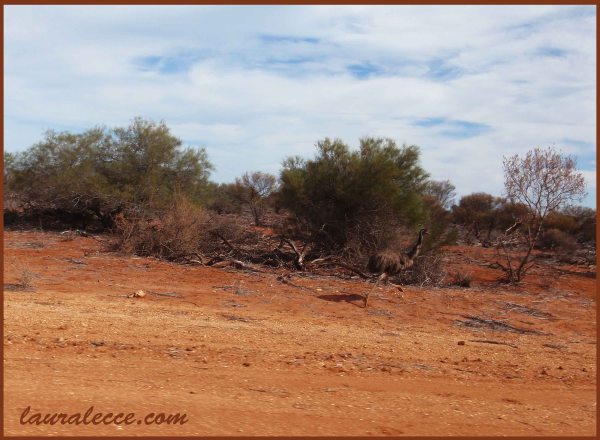
Spot the Emu

Spot the Emu - Photograph by Laura Lecce
Spot the Emu – Photograph by Laura Lecce

Can you spot the emu? This photo was taken on a Western Australian highway on a road trip from Exmouth to Monkey Mia, with a stop at Coral Bay. Coral Bay is a beautiful area where the Ningaloo Reef stretches along the coast just a short swim off the beach – a must see location for snorkelers. Monkey Mia is a famous location in WA where dolphins swim into incredibly shallow waters to get fed and interact with humans. On this remote stretch of road you will witness a very dry landscape with expanses of red dirt to either side. You may see small leafless shrubs with adorable tiny goats huddled underneath trying to seek refuge from the hot sun. Closer to the coast the shrubs get larger and slightly greener, and you may be lucky enough to catch a glimpse of some emus running across the land, darting in amongst the shrubs after being spooked by your car. They remind me of the Looney Tunes character the Roadrunner (with Wile E. Coyote), except that real roadrunners run at a speed of 20 mph (32 km/h), whilst emus can run at 31 mph (50 km/h). Below is a close up photo just in case he ran so fast you missed him!

Click here for posts on other Australian wildlife.
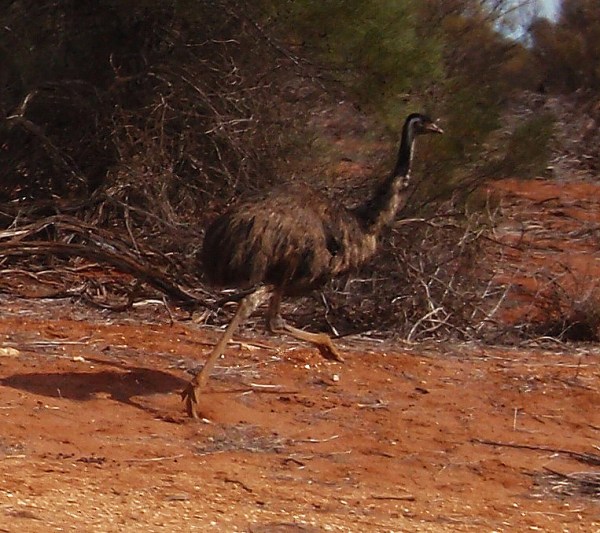
In case you missed him

It wasn’t always so peaceful

It wasn's always peaceful - Photograph by Laura Lecce
It wasn’t always peaceful – Photograph by Laura Lecce

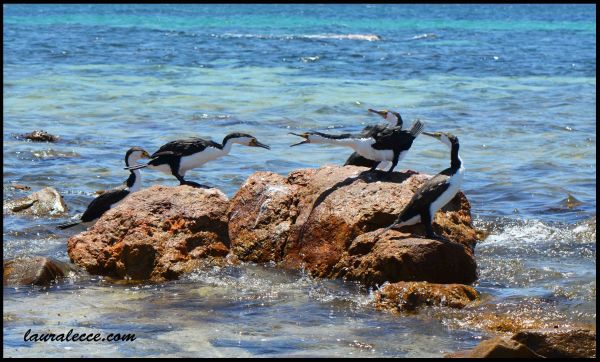
Today is an extra special Friday… the one year anniversary of my blog!!! I want to thank everyone (all of my followers) for your support which has made blogging the wonderful experience it has been so far. Today I am breaking Friday tradition, and instead I want to share with you an alternate photo of one of my earliest posts. The original photo below (click here for original post) was of a peaceful Western Australian seascape with well behaved, black and white cormorants. Todays photo above was taken just moments before that one, the cormorants squabbling over a territorial dispute involving expensive waterfront real estate. Together these photos are the perfect metaphor for how quickly life can change in a mere moment, and that no matter how ugly a current situation is, the calm will eventually arrive.

Life at Sea - Photograph by Laura Lecce
Life at Sea – Photograph by Laura Lecce

Early on in my blog I also had a post on my battle with anxiety, especially bad when I travel on airplanes (click here for post). I am proud to say that two days ago I was courageous enough to fly alone for the first time in about 10 years. It wasn’t a great experience with definite moments of panic, but I calmed myself down and I made it. I did it by myself and I can be very proud of that! So here is to the incredible changes that one minute, one hour, or one year of time can bring to someone’s life. Happy Weekend Everyone!!!

Friday – A Flower and a Fly

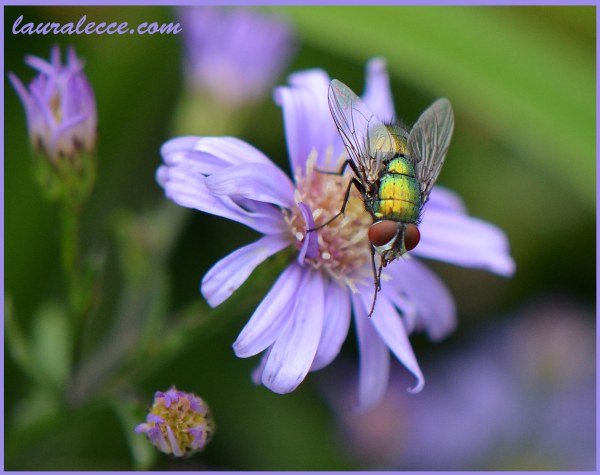
A Flower and a Fly - Photograph by Laura Lecce
A Flower and a Fly – Photograph by Laura Lecce

Today I present to you this fly……on a flower. This fly is called a green bottle fly because of the shiny metallic green color of its body. Flies such as these have very important uses in both forensic science and medicine. They are often the first flies to arrive at a human or animal carcass, and this is where they can begin their lifecycle – A female will lay about 200 eggs which hatch and become larvae in 1-3 days, fully developed larvae in 3-10 days, and pupal development takes 6-14 days after which an adult fly emerges. Forensic investigators can use this knowledge to approximate the length of time a deceased has been dead.

These flies (or more correctly, the maggots) are used by doctors to treat wounds which are unresponsive to conventional treatments. They eat away the dead tissue and bacteria, and also secrete antimicrobial enzymes which together prevents infection and allows healthy tissue to grow successfully. Given the increasing resistance of bacteria to known antibiotics, this may just become the medicine of the future. Sorry to give such a literal example of making your skin crawl….

Happy weekend everyone!

I’m Going Batty

Going Batty - Photograph by Laura Lecce
Going Batty – Photograph by Laura Lecce

So this was an absolute treat…. About a week ago, this furry little bum showed up on a window sill at work. Completely perplexed by this round ball of golden colored fur, it took me a few minutes to figure out that what I was actually looking at was a bat! It was so tiny, like the size of a mouse. I watched closely to make sure he was breathing (as I thought originally that he might be dead), and I wondered what circumstances he had endured to be forced to spend his daily nap on our window sill. The poor little bugger looked so cold that I wished I could have given him a warm cuddle. I regularly checked on this little golden fur ball through out the day, hoping I would eventually see him fly off. Unfortunately, sometime as the sun was setting I missed the takeoff moment, but hoped he would have found his friends. This tiny little guy is very different from the bats I’m used to back in Australia. Some of our bats are much larger and are actually named flying foxes (although we have about 75 species of bats of all different sizes!). Flying foxes are large black bats with a mane of golden fur around their necks, they are seen throughout Sydney. The Royal Botanic Gardens in Sydney was home to a very large colony of flying foxes (over 20,000 of them at times) which took up residence on few leafless trees, completely destroyed to accommodate their numbers. They were incredibly loud, constantly squabbling as they tried to find sleeping room on those poor trees. They have since moved on, but it was always an amazing sight to see and hear so many bats in one place!

Relaxed Goanna

Chilled out goanna - Photograph by Laura Lecce
Chilled out goanna – Photograph by Laura Lecce

This relaxed goanna was photographed in Western Australia, warming up on the sand in the morning sun at the entrance to a gorgeous beach. In Australia we have 25 of the 30 known goanna species. This one would have been about a meter and a half long (about 5 feet). Considering that some goanna species such as Varanus giganteus can grow over 2.5 meters (8.2 feet) long, this one is only medium sized. Even still, goannas can be one of Australia’s more intimidating lizards. I remember once walking along a narrow bush track and in front of me was a large goanna, slowly lumbering in the same direction that I wanted to go. I was not bold enough to overtake him on such a narrow path, nor spook him into hurrying up, so I had to patiently follow until he decided to eventually get off the track and let me pass. These huge lizards can give a very nasty bite which often bleeds profusely. The bleeding was thought to be caused by bacterial infection transferred from their teeth upon biting, but recent research suggests that they may in fact have oral venom-producing glands. If true, this would add another venomous animal to Australia’s huge list of venomous creatures… as if we needed any more!

Friday Flower – My Bleeding Heart Vine

My Bleeding Heart Vine - Photograph by Laura Lecce
My Bleeding Heart Vine – Photograph by Laura Lecce

This adorable little red flower is from a Bleeding Heart Vine (Clerodendrum thomsomiae), a native to tropical west Africa. This plant utilizes two reproductive strategies, dichogamy and herkagomy which mean that the stamens (male reproductive parts) ripen at a different time and are spatially separated to the pistil (female reproductive part), thus ensuring that this plant cannot self pollinate. Instead, the hard work is accomplished by butterflies and hummingbirds which spread the pollen to other plants. This also means that the genetic diversity of this plant is increased through combining the genes of separate plants, providing a higher chance of adaptation and evolutionary survival. Too much science for a Friday? In that case, happy weekend everyone!

Swimming with whale sharks

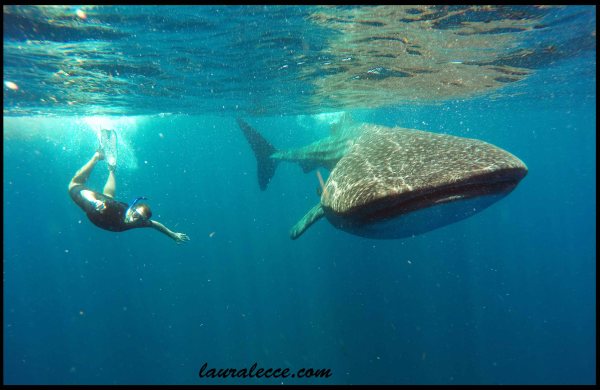
Making Friends with the Fishes - Photograph by Ocean Tours
Making Friends with the Fishes – Photograph by Ocean Tours

This past trip to Mexico we made sure we went when the whale sharks are known to migrate to the warmer waters of the Mexican-Caribbean Sea, usually mid May to September. This photograph was taken by our guide from Ocean Tours, of my husband next to one of these gentle and giant whale sharks. Unfortunately I didn’t make it into many photos because every time I jumped into the water, I was immediately transfixed by the majestic creature in front of me, that I would forget to channel my inner Olympic swimmer to keep up with them! The bus-sized whale sharks were slowly cruising through the water, sucking up plankton without a care in sight, and even with their slow motions easily outswam us. I really enjoyed going on this tour because it felt like Mexican authorities really care about these mysterious beauties. There are many rules and regulations in place to make sure that people are not infringing on the whale sharks natural behaviors, feeding and migratory habits. They limit the season length, the number of boats, and allow only two people with a guide in the water with the shark at any time. They really want to make this a sustainable attraction, and I feel that many countries could use this as a great example that nature should be prioritized over fast monetary gain. Although I am not in any way a comfortable boat person, and after a while was “feeding the fishes” rather than swimming with them, I would recommend this fantastic experience to anyone.

Please click here to see my other underwater posts.

Sloths – how will they ever keep up?

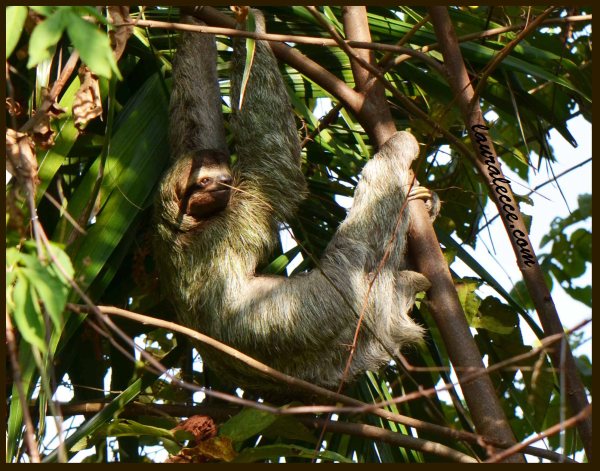
Happy to be Hanging Out - Photograph by Laura Lecce
Happy to be Hanging Out – Photograph by Laura Lecce

Last week on the 20th of November it was international sloth day. These incredibly interesting and bizarre creatures were a highlight on my visit to Costa Rica. Honestly, they are one of those creatures that you hope you will see, but in reality never think you will be lucky enough to actually spot one. I was so very wrong… we actually saw quite a few. We were also lucky enough to see a couple of them on the move (although they move frustratingly slow, making you wonder how they get anywhere they want). You can imagine that in a world where things move so fast, and increasingly so, that these animals may not have a place in the future without a lot of help from humans. However for now, they always have a smile on their face and are truly happy just hanging around. After spotting a few on our own we decided to go on a guided sloth spotting tour to learn more about these fascinating creatures. The two photographs below were taken on a mobile phone through a telescopic lens that our guide had, so I cannot take credit for them, but they clearly show the differences between the two families of sloths. The first is a three-toed sloth with a darker fur, and the second a two-toed sloth with lighter fur.

Three-Toed Sloth
Three-Toed Sloth
Two-Toed Sloth
Two-Toed Sloth

We were lucky to have photos with their heads in them, as they mostly sleep all day, and all you often get to see while looking up into the trees is a furry bum. Being Australian, I think of them as the Central/South American cousin of the Koala. Both move quite slowly, live high up in the trees, spend most of their day sleeping (about 15-20 hours a day) and for the few hours a day they are awake they munch on leaves.

Click here for other posts from Costa Rica.

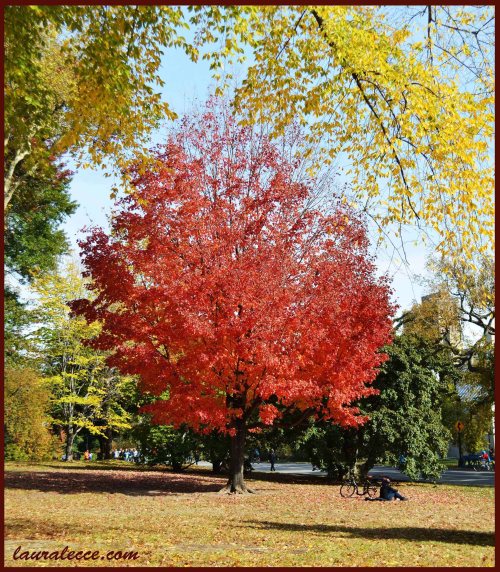
Autumn Colors

Autumn Colors - Photograph by Laura Lecce
Autumn Colors – Photograph by Laura Lecce

The Autumn season is upon us, and many trees in Manhattan are showing signs of changing color. Have you ever wondered how the trees know what season it is? Many trees and plants are photoperiodic, meaning they can detect the hours of darkness in a 24 hour period. In this way, trees and plants can detect the lengthening of nights into winter or shortening of nights heading into summer. This clever ability is achieved through pigments within the leaves called phytochromes, which can trigger a cascade of specific hormones and growth factors which regulate growth, flowering, and changes in leaf color during autumn. Leaves produce chlorophyll throughout most of the year, a green pigment critical for photosynthesis which allows trees and plants to absorb energy from light. Chlorophyll masks other pigments present within the leaf such as carotenes and xanthophyll, which are responsible for orange and yellow coloring, respectively. As the length of night increases during autumn, it triggers a cork-like membrane to form around the base of the leaf stalk called an abscission. The abscission slowly cuts off the supply of nutrients to the leaf, thus limiting the production of chlorophyll and allowing the orange and yellow colors to be visible. Anthocyanin is also produced in autumn, which gives leaves a red and purple coloring. Eventually nutrients to the leaves are completely halted causing the leaves to fall off. After accumulating a certain amount of time in the cold during winter months, which is referred to as the number of chill hours, trees can then respond to the increasingly warmer temperatures and shorter nights of Spring. During this time there is an upregulation of genes responsible for producing antioxidants and vitamin C to rid the tree of hydrogen peroxide which has built up during the winter dormancy. Trees are now able to produce the hormones and growth factors necessary to begin flowering and making new leaves again. Happy Autumn Everyone!

To see my other post on Autumn in New York, please click here.