
For one of the dreariest weather and work weeks I’ve ever had in New York, I needed to inject a little sunshine into the end of it to brighten up my weekend. I hope these golden tulips do the same for you, have a very sunny weekend everyone!

For one of the dreariest weather and work weeks I’ve ever had in New York, I needed to inject a little sunshine into the end of it to brighten up my weekend. I hope these golden tulips do the same for you, have a very sunny weekend everyone!
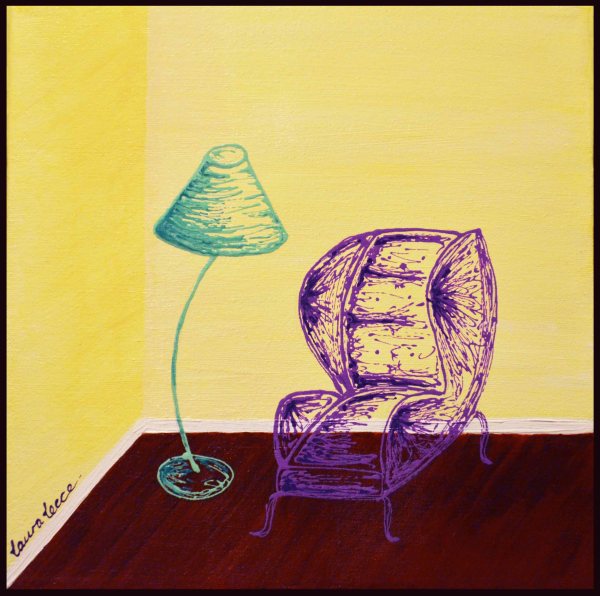
When I was a little kid, my mum used to take me to the library each week to pick out books that we would read together. For many of them I still remember the story, and I know that I will seek them out to read to my children one day. As a teenager I still loved to read, often choosing that over homework. Sadly since the start of my scientific career, I barely read for leisure anymore, there are only so many hours in a day. I do remember the excitement of curling up on the couch with a soft blanket, hot cup of tea and a brand new book. That new book smell and the crispness of the pages that sadly the next generation might not ever know. I also remember the disappointment when a great novel that I was really enjoying comes to an end. Well, I purchased a new book the other day, written by an author who publishes once a year, and each year I purchase her latest novel. I don’t want to start reading it because then it will inevitably end, so instead I am procrastinating with this painting and waiting for the perfect time to curl up with my book.

Sorry to inundate you with such cuteness on Monday morning, but this photo was too adorable to not to share. This pademelon youngster following its mother around is about 6-8 months of age. Interestingly, mum is likely to already have another joey in the pouch. The reproductive cycle is a bit complicated, but stick with me on this. When mum gives birth to a new born (after 3 weeks gestation) the little jelly bean climbs up her tummy and into the pouch where it lives for the next 6 months. As soon as the baby is born, mum is immediately receptive to mating again. If she does and the egg is fertilized, it is put into a state of suspended animation until the current joey exits the pouch. When the pouch is vacated, the blastocyst continues to develop and the newest baby is born. It then climbs into the pouch and attaches itself to a teat for milk. The youngster outside the pouch will still put its head into the pouch for milk (where it meets its younger sibling). Even more interesting is that mum is making newborn milk for the little joey, and from a separate teat, toddler milk for the older sibling, and has a blastocyst in suspended animation as a backup. Talk about a very efficient parenting strategy!
For my other post about pademelons click here.
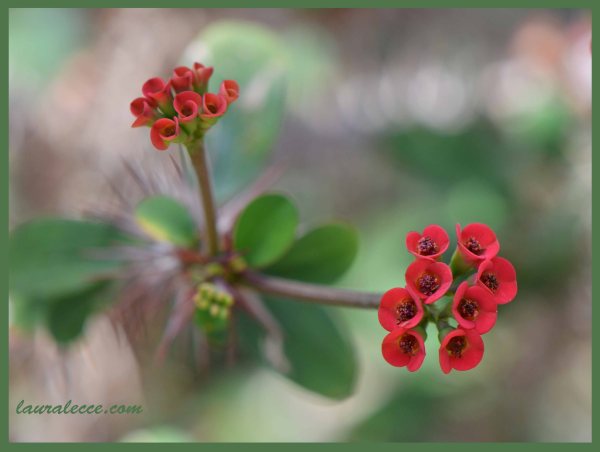
Last month at the New York botanic gardens I went to see the orchid display, when in fact these non-orchid photos turned out to be my favorites. In the dessert section was this beautiful plant native to Madagascar called Euphorbia didieriodes. The plant itself isn’t widely known, and I found little information on it, although other Euphorbias are common house/garden plants. I love these photos mainly because it surprised me that such delicate, cute little red flowers were poking out of a formidably thorny plant!
Happy weekend everyone!
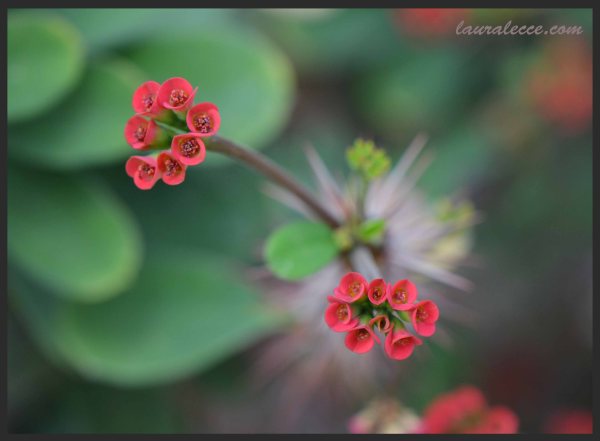

This is a photo from last year while on a mini road trip from Calgary to Banff in Canada. Barely a road trip, it took only about 1.5 hours to drive, but there was just so much to see along the way that it felt like a road trip. Driving in Australia you almost never see scenery like this…a stunning backdrop of snow capped mountains, and a row of Christmas trees (I know that’s not their real name), behind these cute little highway arches. It took me a few tries to get this photo right, sitting in the passenger seat, camera pointed out the front window while my husband drove. Not all the bridges had a backdrop of mountains and I had to get the distance just right before the mountains were obscured behind the bridge. Not bad for highway speed photography!
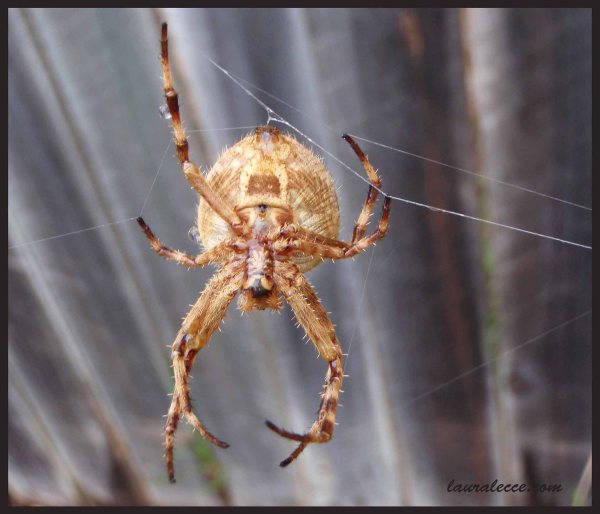
I thought it about time for another spider, also a very common species on the east coast of Australia. Don’t worry, just like the St Andrews Cross spider, this is also one of Australia’s friendly spiders which wont kill you. The garden orb weaver is a beautiful arachnid, easily identified by its signature plump belly. It spends the early evening making a magnificent web and spends the night sitting in the center, waiting for an unsuspecting winged insect to fly into this brilliantly formed trap. During the day, the spider will leave the web and tuck itself away in a rest spot, often a leaf very close to edge of the web. If you are walking around and get a face full of spider web, its usually from these guys, thankfully its most often without the spider on your face too!
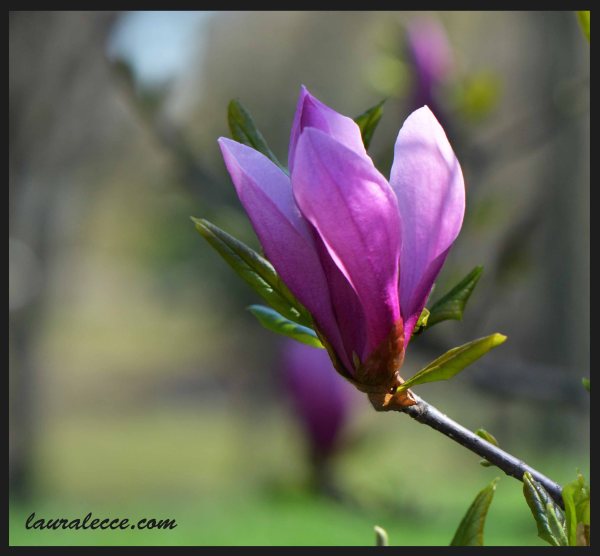
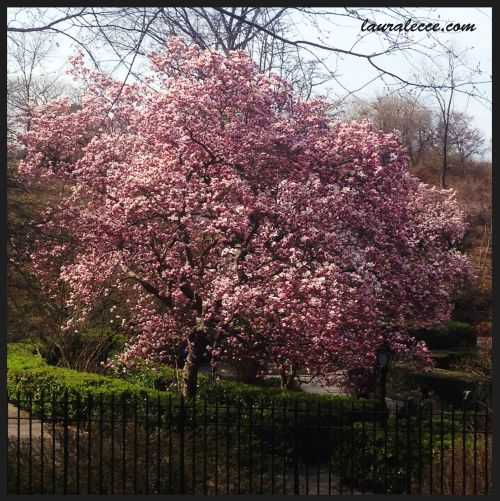
I have to premise this post with the confession that I don’t really like magnolia flowers. I love seeing the trees in full bloom, like a giant cloud of pink color as in the photo below. New York springtime is at its prime at the moment, and the magnolia trees in central park really make a stunning statement.
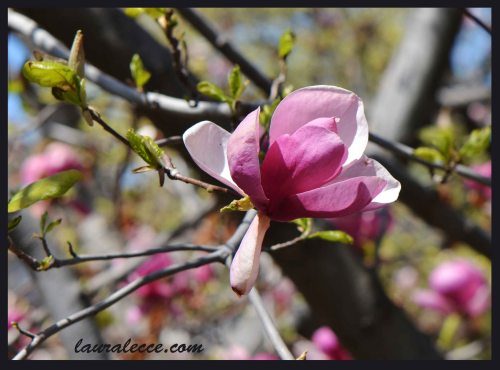
However, when you get closer, there is something imperfect about each flower that disappoints me every time. Maybe its that they have no obvious order, or symmetry about them. Or that by the time the innermost petals open the others look close to dropping off. They are pretty mostly because of the color, but far from making my favorites list. Still very worthy of a photo though, happy weekend everyone!
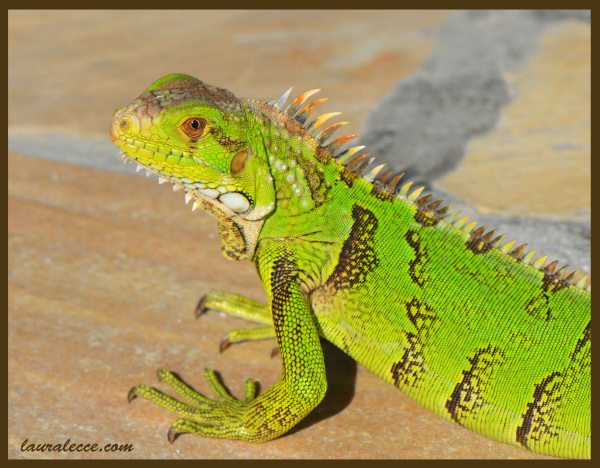
This stunningly beautiful reptile finds its home in a resort in Aruba, a beautiful island in the Caribbean. Actually I was surprised and delighted to find that many iguanas use the resort pool, and surrounding display rocks for their own personal sunning spots. Even more relaxed than the tourists on vacation, these iguanas are so accustomed to having people around them, that they were most obliging to model for some close up portrait photos.

In Tasmania, like many places around the world, springtime means a lot of youngsters are finally out roaming around. Pademelons are marsupials (they have a pouch) which are particularly abundant in Tasmania, Australia. Baby pademelons are born at any time throughout the year, though higher numbers are born at the start of winter and spend the first 6 months in the warmth and safety of mums pouch.
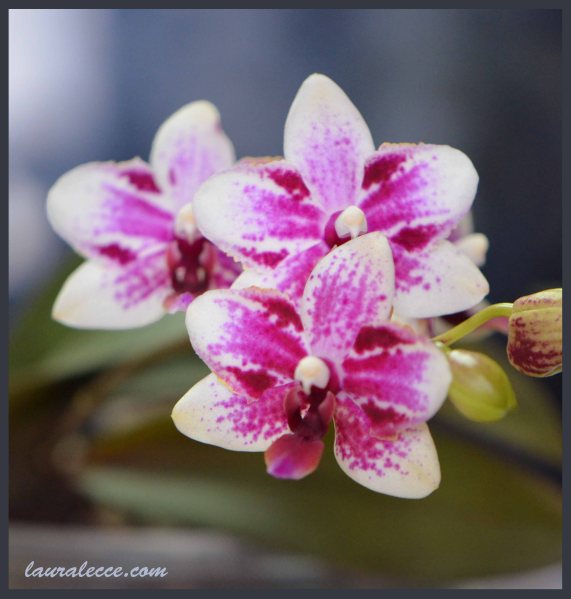
These cute and happy flowers belong to a beautiful little orchid that is a cross between Phalaenopsis Golden Peoker and Doritis Pulcherrima, thus the amalgamated name Doritaenopsis. Each cross will have flowers that are slightly different (more or less dark/light pink, more or less ruffling of the petals), and is an easy and welcome addition to any home orchid collection. Have a wonderful weekend everyone!
 Laura Lecce's art and photography