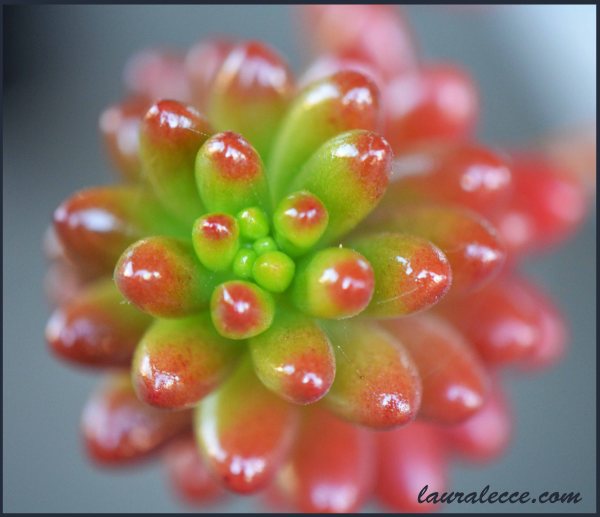
Friday Flower – Jelly bean succulent

Jelly bean succulent – Photograph by Laura Lecce

Succulent sedum rubrotinctum is native to Mexico and a very lovely addition to any succulent garden. It displays lovely green jelly beans along each branch for most of the year except in summer to early spring when it gets a bit more sun it will blush a delicate red. Like most succulents, each individual segment (or bean) can fall off (or be picked off) and will grow roots and a brand new succulent when it touches the soil. The branches of this succulent grow upwards towards the sun and when they become long and heavy enough they will cascade over the side of a pot. For some creative succulent photography (and provided you don’t mind sacrificing your succulent for the sake of a photo) I sprayed this succulent branch with hairspray first to give it a lovely glossy shine. Happy weekend everyone!

For other succulent posts please click here.

Friday Flower – Frangipanis in baby pink

Frangipanis in baby pink - Photograph by Laura Lecce
Frangipanis in baby pink – Photograph by Laura Lecce

One thing I miss since moving to New York is the sweet smell of frangipanis. In Australia they grow in abundance in all but the colder cities and the flowering season goes for months. There are close to 300 different colors of frangipanis and all are incredibly beautiful. These trees make their own perfectly arranged bouquet of flowers at the end of each branch. The flowers are so soft and delicate that it feels great to stick your face and nose into them and take a deep breath of heavenly scent. Even once the flowers drop off they still look perfect and can be used as a beautiful decoration in your home by floating them in a bowl of water. Enjoy the weekend everyone!!!

Friday Flower – Desert Rose

desert-rose

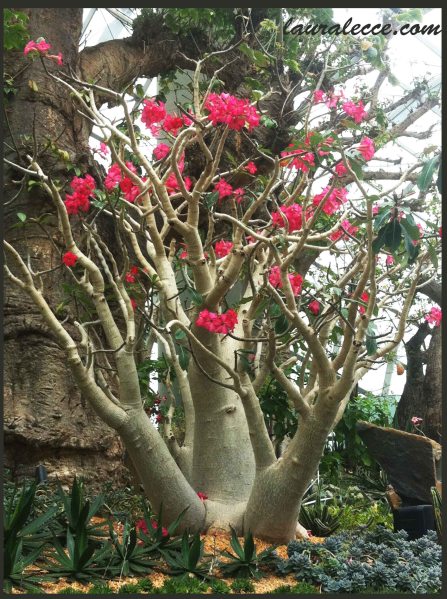
This stunning pink flower is called the dessert rose. Not only is it an impressive flower, but the plant itself is also very unique looking and an attractive plant to have in the garden or as a bonsai. It is native to Africa and The Middle East and is a close relative of the Frangipani and Oleander. The flowers come in various shades of pinks and reds. African hunters use the sap found in the trunk and roots to coat arrows as it contains cardiac glycosides which interfere with the contraction of heart muscle and is extremely toxic. These huge specimens that I photographed are found in the desert section of a stunning gardens in Singapore called Gardens By The Bay. Happy weekend everyone!!!

dessert-rose-plant

Friday Flower – Phalaenopsis as a shimmery sunset

Phalaenopsis - Photograph by Laura Lecce
Phalaenopsis – Photograph by Laura Lecce

When nature created this orchid it was aiming for something truly special. This is an unknown phalaenopsis hybrid whose flowers each year were a highlight amongst my collection. The simultaneously soft and yet bold colors of a sunset radiate from the center to form a backdrop for the branching pink veins across the petals. Soft shimmery glitter peppers the surface and adds an extra touch of magic and awe to an already perfect flower. Nature is the most inspiring of all artists. Happy weekend everyone!

Click here for other orchid posts.

Flower Friday – Edible Dahlias

Pink Dahlia - Photograph by Laura Lecce
Pink Dahlia – Photograph by Laura Lecce

I’ve posted some interesting facts about Dahlias on my blog previously (click here), but did you know they’re also edible? You can eat both the flowers and the tubers (bulbs/roots), with different types having different flavors and some varieties being tastier than others. Another very gorgeous and also potentially yummy addition to your garden!

Check out James Wong’s very interesting post about edible dahlias here.

Happy weekend everyone!

Flower Friday – Leonotis leonurus

Leonotis leanurus - Photograph by Laura Lecce
Leonotis leanurus – Photograph by Laura Lecce

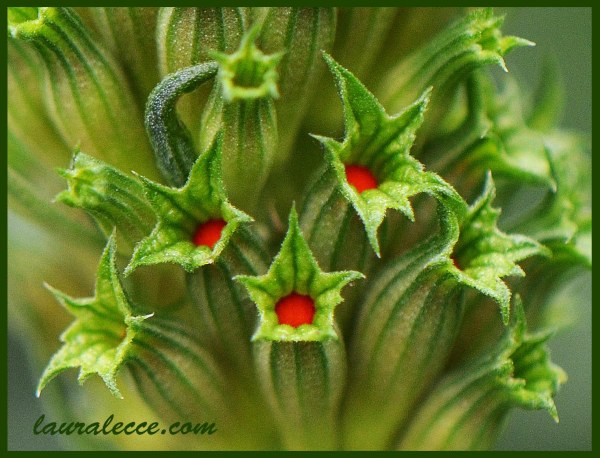
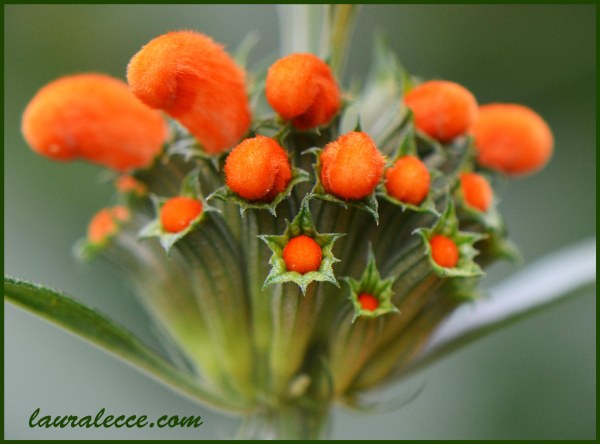
These photos are from the very unusual plant called leonotis leonurus (commonly called lion’s tail or wild dagga) native to South Africa. A very hardy perennial plant belonging to the mint family which is drought resistant, deer resistant and also used as an annual in colder climates. It forms unusual tubular flowers in clusters along the stem with newer clusters appearing at the top. The shape of the flowers are perfectly suited for pollination by sunbirds and hummingbirds, but also attracts butterflies and bees with sweet nectar inside the flowers. This plant has psychoactive compounds with similar effects to cannabis in that smoking dried leaves and flowers can give a mild calming effect (please do not try this on account of my blog!) Leonurine has also been found to have antioxidant, cardio-protective, anti-inflammatory and hypoglycemic (anti-diabetic/blood sugar lowering) properties. The unusual flowers which are commonly orange but also come in a white and yellow variety gave me some very bright and interesting photographs. Happy weekend everyone, see you in 2017!!!

Lions Tail - Photograph by Laura Lecce
Lions Tail- Photograph by Laura Lecce

Friday Flower – Blooming Cactus

Cactus Flowers - Photograph by Laura Lecce
Cactus Flowers – Photograph by Laura Lecce

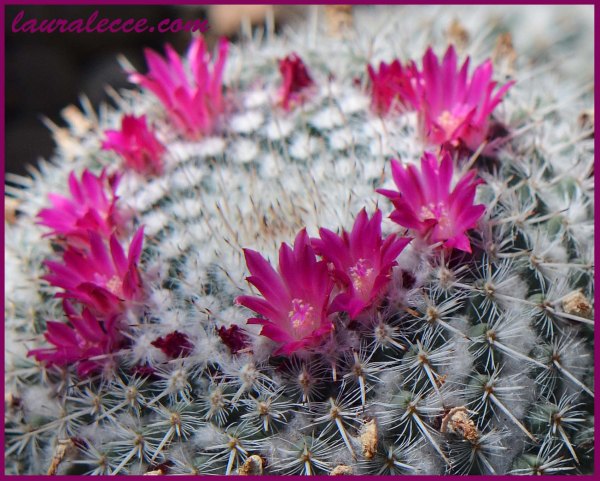
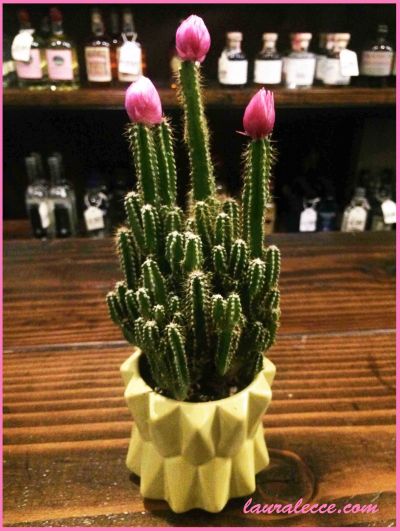
This photo was taken at the New York Botanical Gardens in the desert section of the Enid A. Haupt Conservatory. Cacti produce some of the most stunningly beautiful flowers in the world. These brilliantly colored pink flowers were on the top of a teeny little barrel-shaped cactus. A cactus must be mature to flower and this can take more than 30 years for some cacti, and 40-55 years for the saguaro cactus! A word of warning though, not all cactus flowers are real. I have seen flowering cacti becoming more popular at grocery stores and corner stores, and the same cactus comes in a variety of brightly colored flowers from purples and pinks to oranges and yellows. Wondering how this could be possible, I have felt the flowers to assure myself that they are real. They are technically “real” flowers, just not real cactus flowers. My friend recently purchased one, and was kind enough to provide me a photo (below). These flowers are actually a strawflower (or everlasting flower) which have been glued to the cactus. These flowers can stay in perfect condition long after removal from the plant, and for marketing convenience make a very pretty addition to a cactus.

In a perfect world - Photographed by a good friend
In a perfect world – Photographed by a good friend

Flower Friday – Japanese Toad Lily

Japanese Toad Lily - Photograph by Laura Lecce
Japanese Toad Lily – Photograph by Laura Lecce

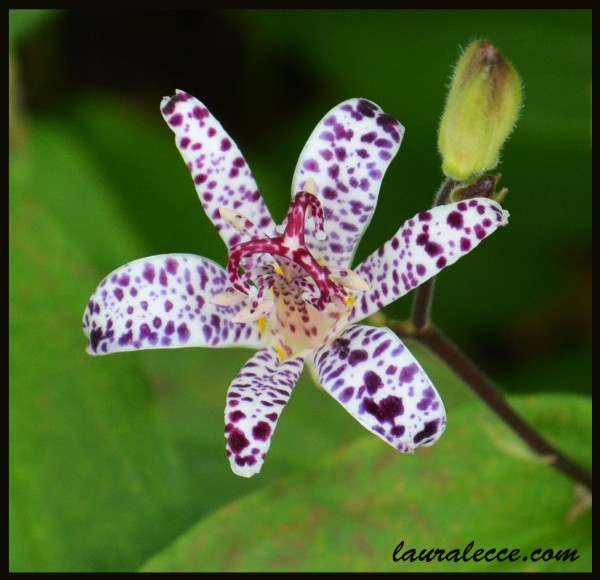
This is a photo of a Japanese Toad Lily, which in my opinion, is quite an unattractive name given to a beautiful flower. This was the first time I have seen or heard of this flower. It is native to Japan, and flowers late in summer to early fall. One particular piece of information that stuck in my mind above all others, is that this flower is deer resistant. To an Australian who has never, and will never experience a deer visiting my garden, this intrigued me. I further found out that deer resistant means that it is not one of their favorite flowers to munch on. If I had the slightest possibility that a deer might visit me, I would be someone who would plant flowers purely to entice deer into my garden. Though I can also understand the frustration of people who want a flower filled garden, and are constantly losing flowers to hungry deer. If you are experiencing that frustration, then supposedly this flower is a good choice for your garden, as it may last longer than other flowers which deer think are yummy to eat.

Have a great weekend everyone, and for other flowers please click here.

Flower Friday – Jade Vine

Jade Vine - Photograph by Laura Lecce
Jade Vine – Photograph by Laura Lecce

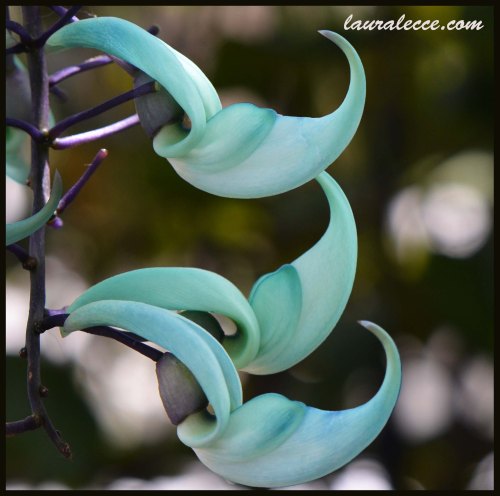
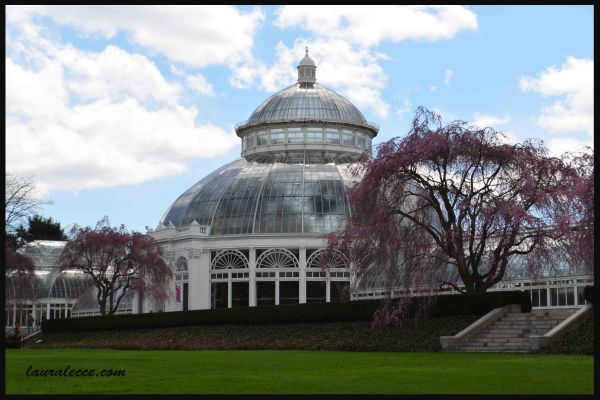
The Jade Vine (not to be confused with the jade plant also known as money tree) is an unusual plant native to the Philippines and is closely related to beans and peas. It grows into a monstrous vine with stems of up to 60 feet (18 meters) and once mature will hang hundreds of cascading flowers, dangling from stems as long as 10 feet (3 meters). These flowers range from a lovely turquoise color to a mint green. The flowers above were photographed from a mighty vine growing inside the Enid A. Haupt Conservatory (photo below) at the New York Botanical Gardens. It is a temperature controlled glass house that contains many tropical plants, which like myself, are most intolerant of New York winters. Happy weekend everyone!

New York Botanical Gardens - Photograph by Laura Lecce
New York Botanical Gardens – Photograph by Laura Lecce