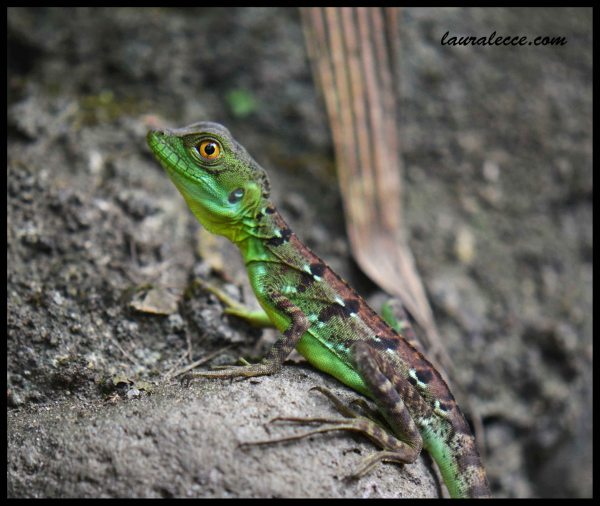
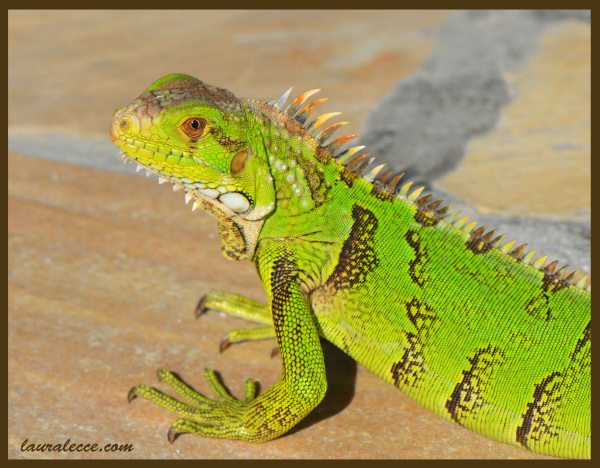
Whilst on vacation in Costa Rica, one of our destinations was the Tabacon Grand Spa located in La Fortuna De San Carlos which is right in the center of a rainforest at the base of the Arenal Volcano. This resort is famous for naturally heated, black volcanic pools of crystal clear water. A heaven on earth for anyone that loves relaxing baths, and luscious tropical gardens. However, as I am not a person who finds sweating in warm water relaxing, I instead was delighted to see that many reptiles obviously loved the humidity and warmth that these thermal hot springs had to offer. The stunning juvenile lizard in this photo was experiencing quite a relaxing day at the spa, until I arrived with my camera. So instead of relaxed, he looks incredibly annoyed at me for ruining his day by taking some photos. Those glaring yellow eyes and pursed lips make me smile every time I look at him, what a cutie!
For those of you who are also reptile lovers, please click here to visit my other scaly posts.
This photo not only marks one of the highlights I experienced on a recent trip to Mexico, but a highlight of my life. The beach we stayed on was incredibly beautiful with endless white sand and calm turquoise water. Just outside our room was an enclosed area with numerous little signs posts in the ground, much like a cemetery (see photo below). Curiously I went to investigate, and to my delight I realized these signs marked mounds of recently laid turtle eggs. Each sign had NIDO written on it (meaning nest in Spanish) with the number of eggs buried (usually 100 or more), and the date they were laid. I was instantly appreciative of the care the resorts have put into this endeavor, when it would certainly have been easier to ignore that they have encroached on a turtle nesting beach. Each night the resort security was seen patrolling the beach, and staff would then relocate any newly laid eggs to these protected areas to stop them getting destroyed by beach goers. As I was reading each of the signs, I realized that literally thousands of baby sea turtles were incubating in the sand in front of me. I quickly Googled how long it takes for baby turtles to hatch and at what time of day, learning that it takes about 8-10 weeks and they hatch at night. As they were mostly laid in August, I knew my chances were slim, but a few had July dates, so I was still hopeful of a newborn turtle sighting.
Turtle Hatchery – Photograph by Laura Lecce.
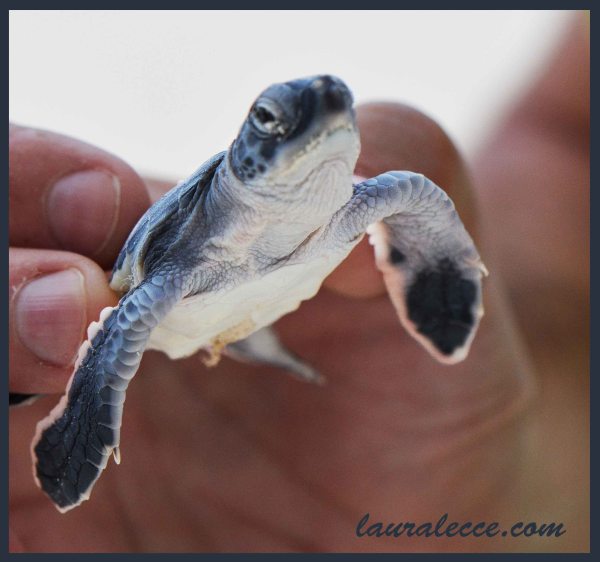
Each night after dark I checked for baby turtles, and was disappointed that they all remained buried. Then, one day at noon when I looked out the window, I glimpsed a tiny movement in the turtle enclosure and ran out to find two little blue babies scurrying around in the sand! Worried that the midday sun would quickly cook them, I sent my husband to notify the resort staff while I guarded my babies. The resort staff came running with their “turtle tub” and let us pick them up to put them in (see photo below). They also tracked the little prints in the sand to identify which nest they were born from and started digging to uncover any more which had hatched, but not yet escaped the sand and found 5 more. I asked if they would take them to the water to release them, and they explained to me that if they did, the birds would quickly eat them, so they keep them safe until nightfall. That night as we were walking along the beach, each of the resorts came to the water with their babies in a tub. One of them contained hundreds of teeny, tiny turtles born that day. We were each handed two turtles to place gently on the sand and watch as they scurried into the ocean waves. I will admit that I cried as I did this, completely overwhelmed at the experience, and of knowing that I helped these little cuties safely reach the water. Simultaneously, my heart was also breaking with the realization that many will not make it far, and instead become prey to the monsters lurking in the dark waters. I was also in absolute awe of mother nature, knowing that one day the few girls that make it to maturity, possess in their tiny brains the GPS coordinates of this same beach, which they will revisit (in 20-50 years) to lay their very own eggs.
Being Born is Hard Work – Photograph by Laura Lecce
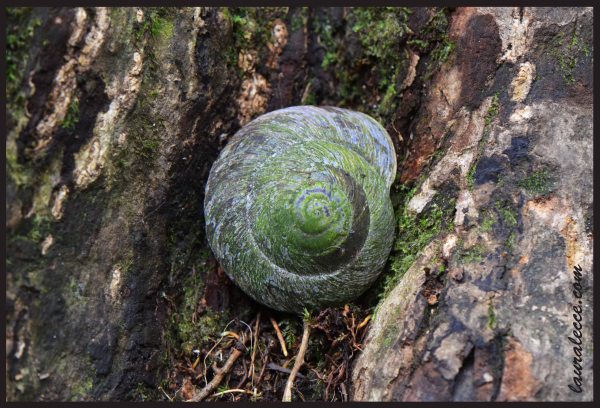
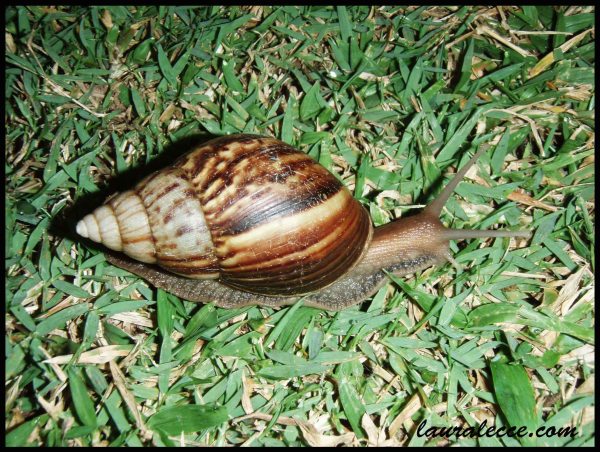
You know you were meant to be a biologist when you get excited to discover that snails from different parts of the world look different. Both Puerto Rican and Malaysian snails are the size of mammoths compared to snails found in Sydney backyards (hopefully this fact makes Sydney gardeners a little happier). However, the shell shapes of these slimy creatures is very different. The snails from Puerto Rico are quite flattened, with the center point of the spiral barely protruding at all (photo above). Malaysian snails have a very elongated shell with the spiral being very pointed (photo below). If you are unlucky enough to have lots of snails in your veggie patch in Sydney, you might one day be lucky enough to attract a blue tongue lizard to your yard. These stocky lizards will happily take care of your slimy infestation, which is reason enough for me to keep feeding the snails in the hope that a lizard one day comes to dinner.
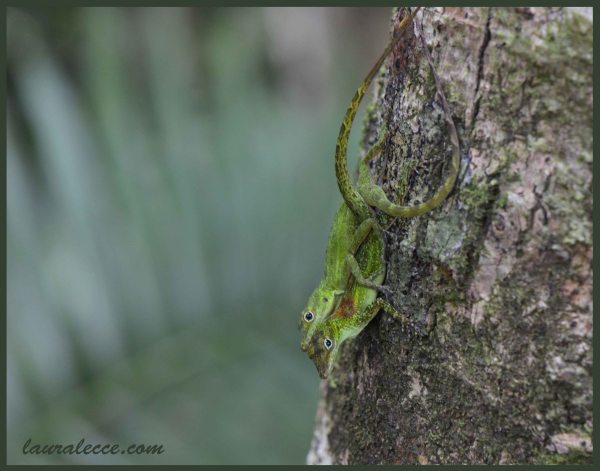
This beautifully intimate photograph was taken on a walk through El Yunque National Forest in Puerto Rico, the only tropical rainforest in the United States National Forest System. This moment was a particularly special one for me, as it was the first (and only) time I have seen lizards mating (and I have seen my fair share of lizards!). I was more careful not to disrupt their mating than I was about the photo, as the last thing I wanted was for these little beauties to miss the chance at making more gorgeous lizards. The actual walk that I was on was to see a waterfall. However, because I spent so much time photographing the lizards along the way, I never actually made it to the waterfall, as I would have missed my flight (but I saw so many lizards along the way, that I wasn’t even a little disappointed!).
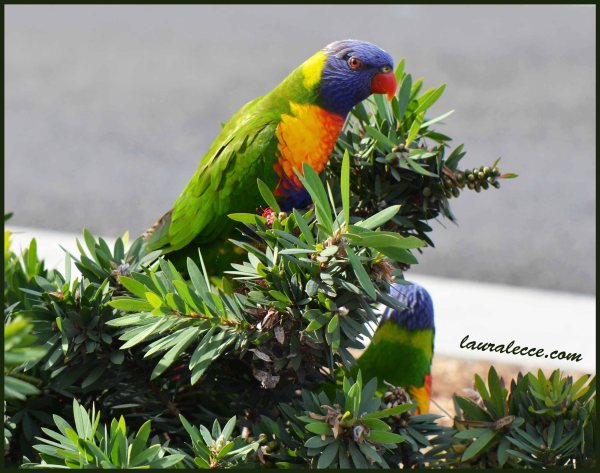
I had forgotten what it was like in Australia waking up to such distinctive bird calls. Those which I had listened to my entire childhood, but only recently paid attention to. The earliest birds are the kookaburras (click here for post) with their loud and projecting laughs, mocking the sun as it rises. They wake the cockatoos, who show their distain with long and piercing screeches. Next are the large flocks of rainbow lorikeets (in the photo) which can be heard having territorial squabbles across the trees with their sharp and angry chirps. They are one of Australia’s most colorful birds, and like other parrots, they know how to be noisy! They mostly travel in pairs, and once paired will be monogamous for life. When feeding in a flock, the male will threateningly hop around his partner while she feeds to make sure no other birds interrupt her meal. They eat fruit, pollen and nectar, mostly from native Australian trees and shrubs such as the eucalyptus, and the bottle brush (Callistemon) seen in this photo. It’s hard to be angry about being woken up early when the birds are as pretty as these ones!
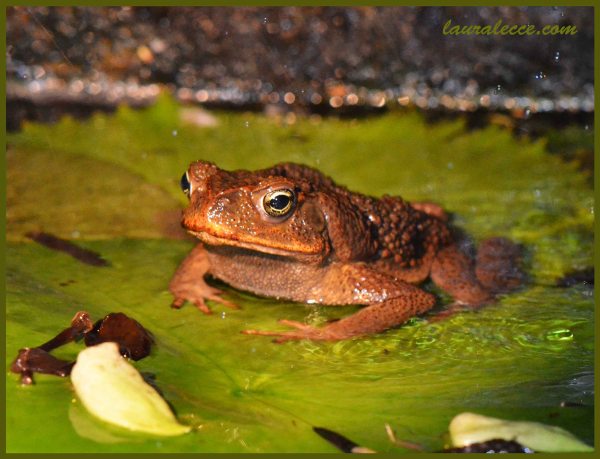
If you can find it in your heart to look beyond the belly fat and brown pimply skin you will see the golden glistening eyes of this glorious toad. Living in a luxurious resort in St Lucia, this toad was clearly the queen of this pond, each night posing proudly atop the lilies. St Lucia is one of the homes of the cane toad (Rhinella marina) also known as the giant neotropical toad. On average they grow to about 10-15cm (4-6 inches), but have been recorded as large as 38cm (15 inches) and weighing 2.65kg (5.8lb). This toad was introduced into northern Australia as a predator to combat the beetles which were eating sugar cane crops. This turned out to be a futile endeavor since the beetles kept to the top of the sugar canes and the toads have poor climbing skills, so instead the toads outcompete many Australian reptiles and frogs for food which is easier to access. So as beautiful as they may be under that brown pimply skin, they should have stayed at home.
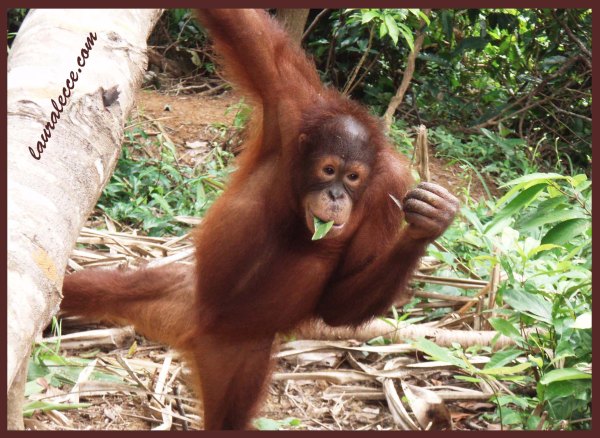
One of my most memorable wildlife experiences was visiting an orangutan sanctuary at the Rasa Ria Nature Reserve in Kota Kinabalu, East Malaysia. This reserve provides protected space where orphaned orangutans are rehabilitated and hopefully reintroduced into their natural habitat. Here the orangutans are taught the skills they need to eventually live an independent life. Orangutans are native to Indonesia and Malaysia and are currently found only in the rainforests of Borneo (island shared by Malaysia, Indonesia and Brunei) and Sumatra (Indonesian island). Watching juvenile orangutans is such a heartwarming pleasure. They are intelligent, playful, inquisitive and tactile animals, that it brings sadness to remember that they are at the sanctuary because of poaching and deforestation. Though it is because of these sanctuaries that people are made aware, educated and hopefully interested in actively saving these precious animals.
Sorry to inundate you with such cuteness on Monday morning, but this photo was too adorable to not to share. This pademelon youngster following its mother around is about 6-8 months of age. Interestingly, mum is likely to already have another joey in the pouch. The reproductive cycle is a bit complicated, but stick with me on this. When mum gives birth to a new born (after 3 weeks gestation) the little jelly bean climbs up her tummy and into the pouch where it lives for the next 6 months. As soon as the baby is born, mum is immediately receptive to mating again. If she does and the egg is fertilized, it is put into a state of suspended animation until the current joey exits the pouch. When the pouch is vacated, the blastocyst continues to develop and the newest baby is born. It then climbs into the pouch and attaches itself to a teat for milk. The youngster outside the pouch will still put its head into the pouch for milk (where it meets its younger sibling). Even more interesting is that mum is making newborn milk for the little joey, and from a separate teat, toddler milk for the older sibling, and has a blastocyst in suspended animation as a backup. Talk about a very efficient parenting strategy!
This stunningly beautiful reptile finds its home in a resort in Aruba, a beautiful island in the Caribbean. Actually I was surprised and delighted to find that many iguanas use the resort pool, and surrounding display rocks for their own personal sunning spots. Even more relaxed than the tourists on vacation, these iguanas are so accustomed to having people around them, that they were most obliging to model for some close up portrait photos.
In Tasmania, like many places around the world, springtime means a lot of youngsters are finally out roaming around. Pademelons are marsupials (they have a pouch) which are particularly abundant in Tasmania, Australia. Baby pademelons are born at any time throughout the year, though higher numbers are born at the start of winter and spend the first 6 months in the warmth and safety of mums pouch.





 Laura Lecce's art and photography