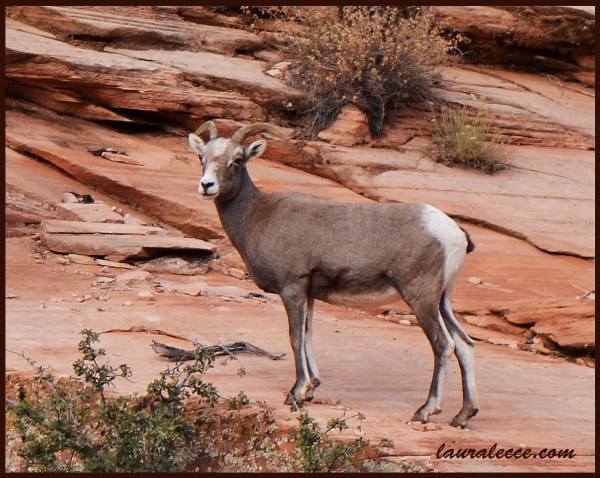
Bighorn Sheep (which looks more like a goat to me)

Bighorn Sheep - Photograph by Laura Lecce
Bighorn Sheep – Photograph by Laura Lecce

This dainty female bighorn sheep lives in Zion National Park in Utah. Zion has the perfect landscape for these sure-footed animals which gracefully hop around on very treacherous-looking cliff faces with incredible ease. They can navigate these terrains even as little lambs because pregnant mothers seek higher ground to give birth which is safer from predators. However, the areas that are safer from predators are less favorable for growing sufficient vegetation, so as soon as the lambs are agile on their feet they will follow their mother back down the cliff faces to find food. These animals are native to North America and their numbers suffered greatly with the introduction of domestic sheep which carry pathogens that are easily spread to wild populations. To me these bighorn sheep look more like goats and equally amusing to me, the white and fluffy mountain goats look more like sheep.  Zion has a herd of over 400 sheep and is a great location to see these gorgeous creatures which are most often spotted between the tunnel and east entrance to the park.

For other posts about Zion National Park please click here.

Bat in a bind

Bat in a bind - Photograph by Laura Lecce
Bat in a bind – Photograph by Laura Lecce

This is an Australian flying fox hanging on my parents garden fence. Australia has a few different species of flying fox, some of which are among the largest bats in the world. Some people may be horrified by this devilish-looking vampire-like creature, but actually they have a very cute face. They are fruit, flower and nectar eaters by night and by day they are busy sleeping (when they are not screeching at neighbors for space on overpopulated tree houses). They live in huge family groups which can have thousands of bats. Unlike most bats they do not use echolocation as they have great vision and are known to use geographical landmarks to find their way home. How did this bat end up in my parents yard in broad daylight? Well, my dad had realized that his figs were getting eaten (usually it’s the birds that get to them). So he covered the fig trees with netting to stop the birds from accessing the fruit. My mum awoke the next morning to find an angry bat tangled in the netting which had been trying to get to the fruit, and a very curious cat on the fence keeping a close eye on this mysterious find. She called my brother to get some scissors to cut the bat out of the netting, which he did, all the while trying not to get bitten by this agitated critter. After being freed from the net the exhausted bat hung on the fence a while to find the energy to fly away home. (Photo is courtesy of my mum.)

Black currawong and her honey bush

Black currawong and her honey bush - Photograph by Laura Lecce
Black currawong and her honey bush – Photograph by Laura Lecce

This intense-looking bird is a black currowong native to Australasia that I photographed while hiking in Tasmania. These birds look quite similar to Australian magpies except that their eye color is yellow instead of red. They have a very special relationship with the richea honey bush and were featured in a David Attenborough narrated documentary called Life in the episode on plants. The honey bush encases its flowers in individual little pods which protect the flowers from cold weather and icy winds that are common in Tasmania. Unfortunately it also prevents successful pollination of the flowers by insects which cannot access them nor remove the protective outer casing. When warmer weather comes along the flowers produce a nectar which attracts the currawongs. They go about their day pulling off each of the little flower pods to access the nectar which also exposes the flowers to pollinating insects and thus the plant can reproduce.

For other posts from Tasmania please click here, or for birds please click here.

Angry Caracara

Angry Caracara
Angry Caracara – Photograph by Laura Lecce

This is an angry looking bird if ever I saw one! It is a caracara, which is a bird of prey belonging to the same family as falcons. Unlike falcons which are fast flying and skilled aerial hunters, these are the slower and lazier cousins which prefer to scavenge for prey that is already injured or dead. I’m pretty sure this is a northern caracara which has a less defined, patchy barring across the chest. The skin on their face ranges from yellow to deep red/pink depending on the age of the bird. This one was photographed in the Washington Slagbaai National Park in Bonaire, and as you can see he was not too happy about the photo.

For other posts on birds please click here.

Spotted Eagle Ray

spotted-eagle-ray2
Spotted Eagle Ray – Photograph by Laura Lecce

This week I wanted to continue the theme of spotted sea creatures. This is a spotted eagle ray, also seen while snorkeling off the beach in Jamaica. They live in tropical waters and have one of the longest tails compared to other sting rays. Unlike most other fish they give birth to live baby sting rays. I must apologize for the bad photography, this ray did not make things easy for me at all. He instantly knew the second I had spotted him (pun intended) and took off so fast that I had to channel my inner Olympic swimmer to get any photo at all! These beautiful underwater creatures are named eagles for a reason, they truly do appear as though they are flying underwater with no resistance at all…. the absolute opposite of my clumsy thrashing and getting nowhere at all.

spotted-eagle-ray
Spotted Eagle Ray in Jamaica – Photograph by Laura Lecce

Jamaican shore crab

Jamaican shore crab - Photograph by Laura Lecce
Jamaican shore crab – Photograph by Laura Lecce

Today we start the week off with this smiley shore crab from Jamaica. This crab made me realize just how many different creatures are decorated with white spots and lines (one of which is the whale shark, click here for post). People tend not to pay too much attention to crabs unless they can eat them, they are however fascinating to watch. These shore crabs may look like they have thin spindly legs, but they are fantastic at holding on even when the rocks are getting pummeled with waves. They eat just about anything and everything including any animals that are sick or dead, but they also eat worms, barnacles, clams, mussels, snails and algae. Their biggest fear are sea gulls especially when the crabs are malting (because their new shell is still a bit soft), which explains why they are so quick to scurry to safety under a rock ledge if you startle them. Thankfully this one was quite willing to pose for my photos.

Reg-eyed tree frog

Red-eyed tree frog - Photograph by Laura Lecce
Red-eyed tree frog – Photograph by Laura Lecce

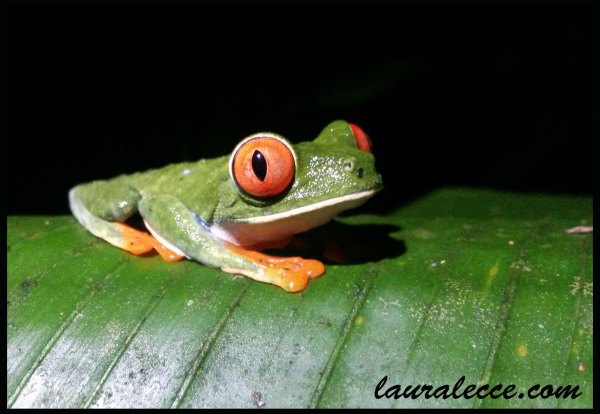
This glossy and colorful red-eyed tree frog lives in the jungle of Costa Rica. While visiting I attended a frog spotting tour which taught us how to listen for frog calls, spot the glistening eyes in our torch light and hopefully find the tiny frog making so much noise. It was harder than I thought! These frogs are very well camouflaged when they want to be. By tucking their orange toes under their belly and closing their eyes, the entire frog is as green as the leaf they’re sitting on. You can’t see it in this photo, but these frogs also have a fair bit of blue along the side of their body and upper arm which gets hidden when they tuck in their limbs. Their beautiful coloration and comical face makes them a very popular subject in animal photography. The bulging red eyes are great for startling predators who think they can make a meal out of a sleeping frog, and also signaling that this frog is not as tasty a meal as a predator might think. The eyes also help the frog swallow larger mouthfuls, this is done by pulling the eyes inwards which pushes the food down into their belly. I definitely had a great time observing some of the night activity that is usually only heard by humans.

For other posts from Costa Rica please click here.

The deer imposter

The deer imposter - Photograph by Laura Lecce
The deer imposter – Photograph by Laura Lecce

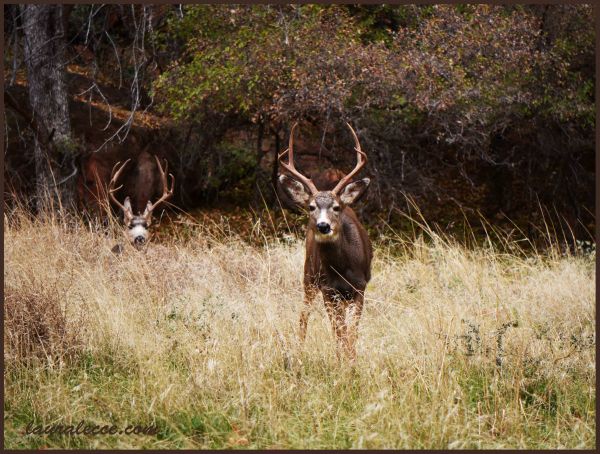
I was so lucky to visit Zion National Park over Thanksgiving weekend, and what a truly spectacular part of the world. There are so many white tailed deer everywhere you turn which was a delight to anyone with a camera. This was my first time seeing a deer with antlers, which of course signifies that this deer is a male. It was quite a delight to see males of various ages with juveniles having small protruding antlers of only a few inches long, to older males with antlers that are very large and elaborately branching. Interesting side fact is that male Chinese water deer do not have antlers, they have tusks and look incredibly strange. So anyway, I took the above photo of a very proud and glorious stag. What makes me laugh about this photo is the male deer hiding in the background, which actually looks more like a dog wearing antlers (with his puffy white cheeks and upwards pointed ears). What a cutie pie!

Spot the Emu

Spot the Emu - Photograph by Laura Lecce
Spot the Emu – Photograph by Laura Lecce

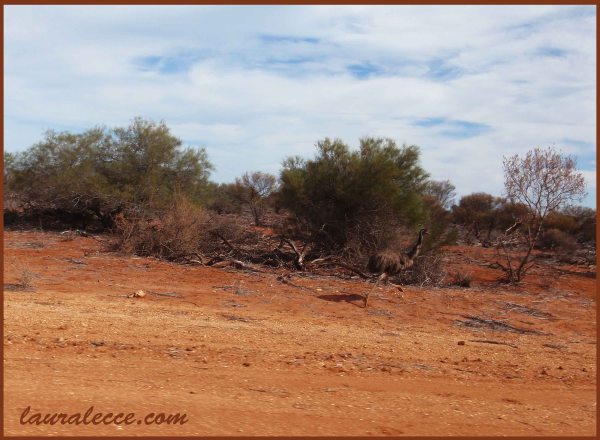
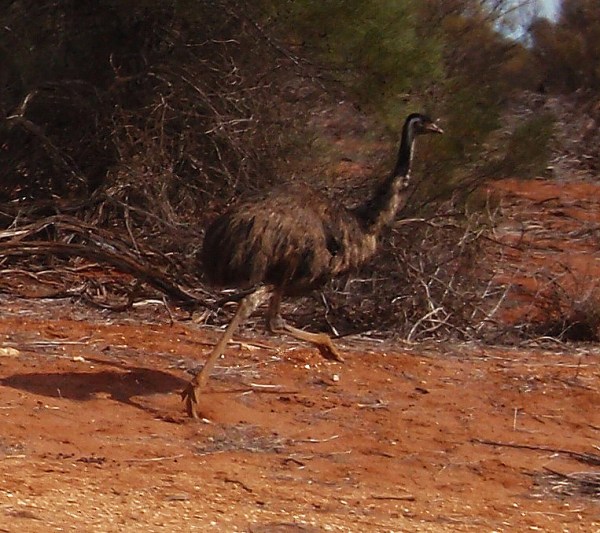
Can you spot the emu? This photo was taken on a Western Australian highway on a road trip from Exmouth to Monkey Mia, with a stop at Coral Bay. Coral Bay is a beautiful area where the Ningaloo Reef stretches along the coast just a short swim off the beach – a must see location for snorkelers. Monkey Mia is a famous location in WA where dolphins swim into incredibly shallow waters to get fed and interact with humans. On this remote stretch of road you will witness a very dry landscape with expanses of red dirt to either side. You may see small leafless shrubs with adorable tiny goats huddled underneath trying to seek refuge from the hot sun. Closer to the coast the shrubs get larger and slightly greener, and you may be lucky enough to catch a glimpse of some emus running across the land, darting in amongst the shrubs after being spooked by your car. They remind me of the Looney Tunes character the Roadrunner (with Wile E. Coyote), except that real roadrunners run at a speed of 20 mph (32 km/h), whilst emus can run at 31 mph (50 km/h). Below is a close up photo just in case he ran so fast you missed him!

Click here for posts on other Australian wildlife.

In case you missed him

It wasn’t always so peaceful

It wasn's always peaceful - Photograph by Laura Lecce
It wasn’t always peaceful – Photograph by Laura Lecce

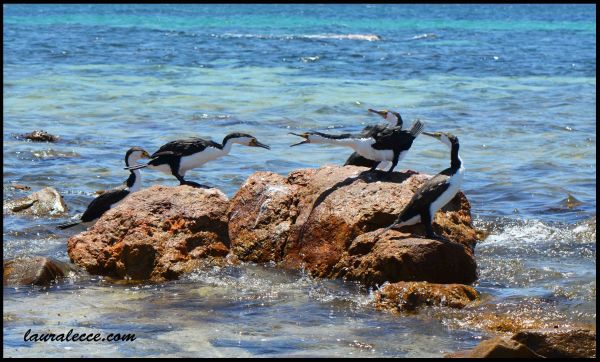
Today is an extra special Friday… the one year anniversary of my blog!!! I want to thank everyone (all of my followers) for your support which has made blogging the wonderful experience it has been so far. Today I am breaking Friday tradition, and instead I want to share with you an alternate photo of one of my earliest posts. The original photo below (click here for original post) was of a peaceful Western Australian seascape with well behaved, black and white cormorants. Todays photo above was taken just moments before that one, the cormorants squabbling over a territorial dispute involving expensive waterfront real estate. Together these photos are the perfect metaphor for how quickly life can change in a mere moment, and that no matter how ugly a current situation is, the calm will eventually arrive.

Life at Sea - Photograph by Laura Lecce
Life at Sea – Photograph by Laura Lecce

Early on in my blog I also had a post on my battle with anxiety, especially bad when I travel on airplanes (click here for post). I am proud to say that two days ago I was courageous enough to fly alone for the first time in about 10 years. It wasn’t a great experience with definite moments of panic, but I calmed myself down and I made it. I did it by myself and I can be very proud of that! So here is to the incredible changes that one minute, one hour, or one year of time can bring to someone’s life. Happy Weekend Everyone!!!