Sloths – how will they ever keep up?

Happy to be Hanging Out - Photograph by Laura Lecce
Happy to be Hanging Out – Photograph by Laura Lecce

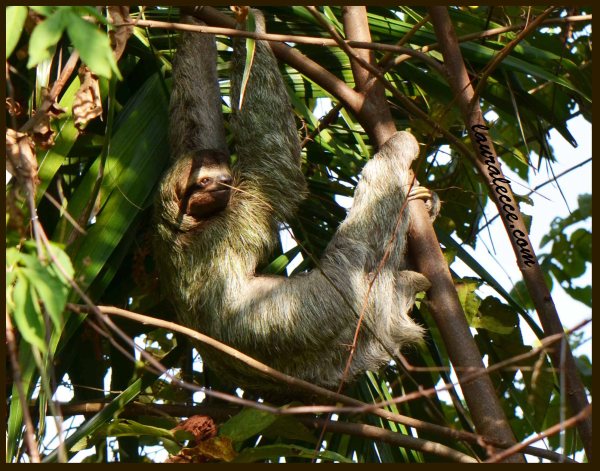
Last week on the 20th of November it was international sloth day. These incredibly interesting and bizarre creatures were a highlight on my visit to Costa Rica. Honestly, they are one of those creatures that you hope you will see, but in reality never think you will be lucky enough to actually spot one. I was so very wrong… we actually saw quite a few. We were also lucky enough to see a couple of them on the move (although they move frustratingly slow, making you wonder how they get anywhere they want). You can imagine that in a world where things move so fast, and increasingly so, that these animals may not have a place in the future without a lot of help from humans. However for now, they always have a smile on their face and are truly happy just hanging around. After spotting a few on our own we decided to go on a guided sloth spotting tour to learn more about these fascinating creatures. The two photographs below were taken on a mobile phone through a telescopic lens that our guide had, so I cannot take credit for them, but they clearly show the differences between the two families of sloths. The first is a three-toed sloth with a darker fur, and the second a two-toed sloth with lighter fur.

Three-Toed Sloth
Three-Toed Sloth
Two-Toed Sloth
Two-Toed Sloth

We were lucky to have photos with their heads in them, as they mostly sleep all day, and all you often get to see while looking up into the trees is a furry bum. Being Australian, I think of them as the Central/South American cousin of the Koala. Both move quite slowly, live high up in the trees, spend most of their day sleeping (about 15-20 hours a day) and for the few hours a day they are awake they munch on leaves.

Click here for other posts from Costa Rica.
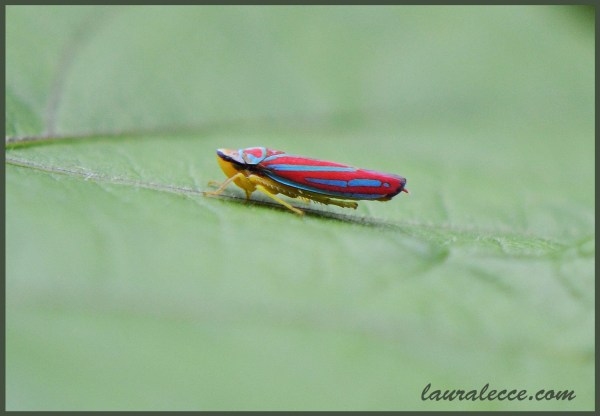
Red-Banded Leafhopper

Leafhopper - Photograph by Laura Lecce
Leafhopper – Photograph by Laura Lecce

Gary I found one!!! Australia definitely doesn’t have such boldly colored leafhoppers, they are mostly a boring green color, making them very hard to spot amongst the leaves. In contrast, this red-banded leafhopper I found in Central Park is incredibly colorful, and doesn’t blend in at all. Native to North and Central America, this insect is so teeny tiny, it makes some ants look big! I wouldn’t have even known what I was looking at if it wasn’t for a post by Gary on his blog called krikitarts showcasing this spectacular insect (click here for post), with a fantastic photo as well. As soon as I spotted it, I was so excited to see one for myself. It was incredibly hard to photograph as the breeze kept moving the leaf, and the little critter wouldn’t stay still at all, and he’s so tiny I kept losing him, so this is as good a photo as I could get. This colorful insect certainly brightened up my overcast and dreary Sunday afternoon.

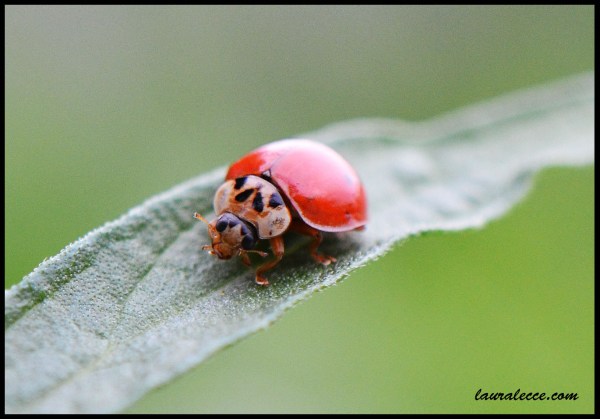
A lucky Lady

A Lucky Lady - Photograph by Laura Lecce
A Lucky Lady – Photograph by Laura Lecce

Life is supposedly based on a simple equation… Work hard and you will be successful. This may be somewhat true, but I believe that a whole heap of luck is also involved. There are many things you can do in life to increase your chances at being lucky – optimism, open mindedness and determination will go far in helping you live the life you consider successful, which of course, is very different for all of us. So today I offer you this lady beetle, which is considered a sign of good luck by many cultures. My grandmother strongly believes in luck, and would tape four-leaf clovers to all of the framed photos she had around the house. When I was a young child I would go hunting in the garden to find shiny red, yellow or orange lady beetles. After returning from the garden with one in my hand, my grandmother used to recite a nursery rhyme in Italian as she was tracing circles around the lady beetle on my palm. I no longer remember the words of the rhyme, but it was telling the lady beetle to fly away and find me a husband. As it turns out, a month after my husband and I started dating he went to Italy with his parents for 2 months. On his return he gifted me a necklace with a beautiful lady beetle charm attached, and 5 years on we were married. So, sometimes in life working hard doesn’t mean anything at all, you just need a little luck and a lady beetle.

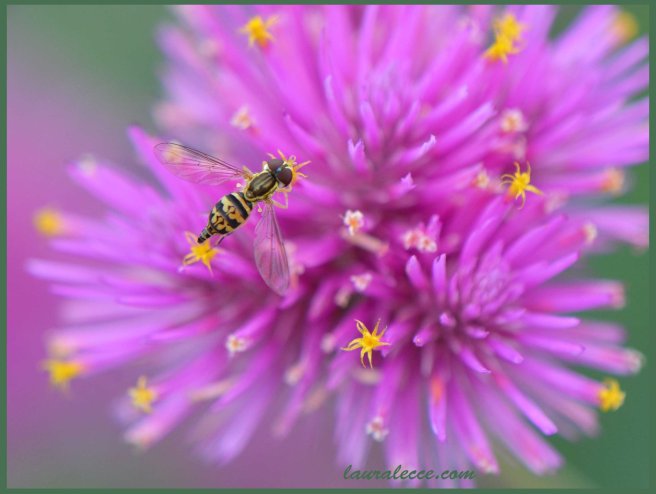
The Magic of a Hoverfly

Hoverfly - Photograph by Laura Lecce
Hoverfly – Photograph by Laura Lecce

This weekend I met a magical hoverfly. Why magical? Because this is by far the most magical and festive photograph I have ever taken. As soon as I saw the result, I imagined this fly to be a character out of Alice in Wonderland. Those giant round eyes and delicate transparent wings are perfect compliments to the whimsical pattern of his yellow behind – hovering above a background of delicate pinks and greens, punctuated with bright yellow stars which complete this beautiful world. A snapshot of the most perfect moment in time and space.

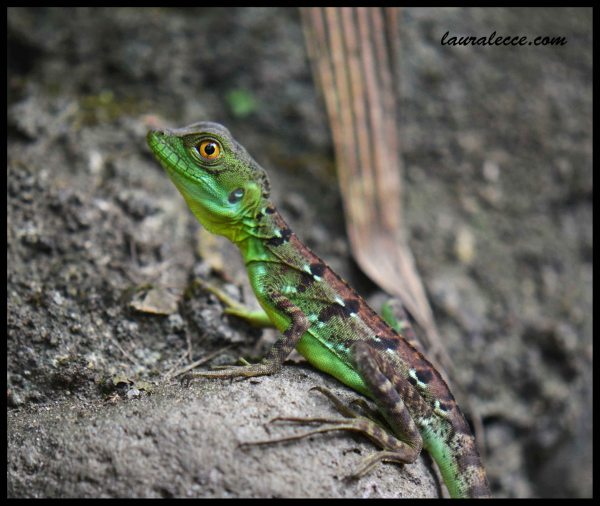
Totally Annoyed

Totally Annoyed - Photograph by Laura Lecce
Totally Annoyed – Photograph by Laura Lecce

Whilst on vacation in Costa Rica, one of our destinations was the Tabacon Grand Spa located in La Fortuna De San Carlos which is right in the center of a rainforest at the base of the Arenal Volcano. This resort is famous for naturally heated, black volcanic pools of crystal clear water. A heaven on earth for anyone that loves relaxing baths, and luscious tropical gardens. However, as I am not a person who finds sweating in warm water relaxing, I instead was delighted to see that many reptiles obviously loved the humidity and warmth that these thermal hot springs had to offer. The stunning juvenile lizard in this photo was experiencing quite a relaxing day at the spa, until I arrived with my camera. So instead of relaxed, he looks incredibly annoyed at me for ruining his day by taking some photos. Those glaring yellow eyes and pursed lips make me smile every time I look at him, what a cutie!

For those of you who are also reptile lovers, please click here to visit my other scaly posts.

Baby Blues in Mexico

Baby Blues - Photograph by Laura Lecce
Baby Blues – Photograph by Laura Lecce

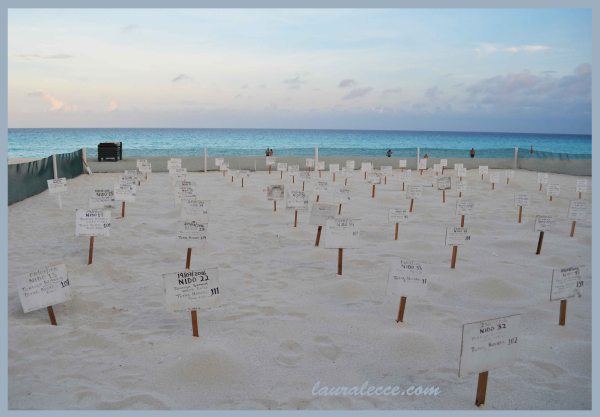
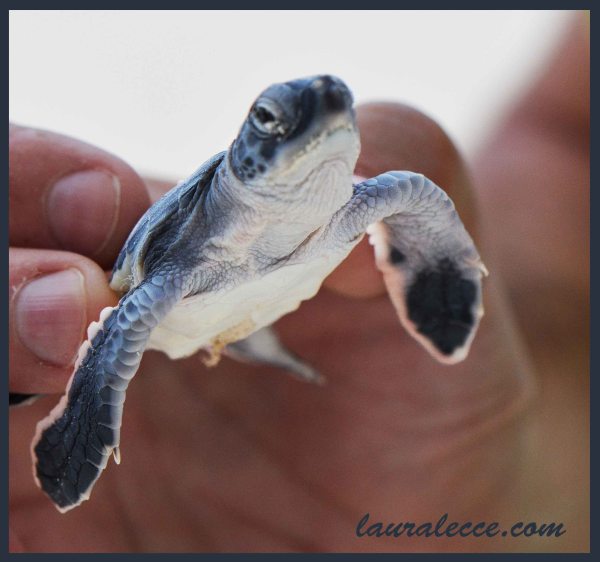
This photo not only marks one of the highlights I experienced on a recent trip to Mexico, but a highlight of my life. The beach we stayed on was incredibly beautiful with endless white sand and calm turquoise water. Just outside our room was an enclosed area with numerous little signs posts in the ground, much like a cemetery (see photo below). Curiously I went to investigate, and to my delight I realized these signs marked mounds of recently laid turtle eggs. Each sign had NIDO written on it (meaning nest in Spanish) with the number of eggs buried (usually 100 or more), and the date they were laid. I was instantly appreciative of the care the resorts have put into this endeavor, when it would certainly have been easier to ignore that they have encroached on a turtle nesting beach. Each night the resort security was seen patrolling the beach, and staff would then relocate any newly laid eggs to these protected areas to stop them getting destroyed by beach goers. As I was reading each of the signs, I realized that literally thousands of baby sea turtles were incubating in the sand in front of me. I quickly Googled how long it takes for baby turtles to hatch and at what time of day, learning that it takes about 8-10 weeks and they hatch at night. As they were mostly laid in August, I knew my chances were slim, but a few had July dates, so I was still hopeful of a newborn turtle sighting.

Turtle Hatchery - Photograph by Laura Lecce
Turtle Hatchery – Photograph by Laura Lecce.

Each night after dark I checked for baby turtles, and was disappointed that they all remained buried. Then, one day at noon when I looked out the window, I glimpsed a tiny movement in the turtle enclosure and ran out to find two little blue babies scurrying around in the sand! Worried that the midday sun would quickly cook them, I sent my husband to notify the resort staff while I guarded my babies. The resort staff came running with their “turtle tub” and let us pick them up to put them in (see photo below). They also tracked the little prints in the sand to identify which nest they were born from and started digging to uncover any more which had hatched, but not yet escaped the sand and found 5 more. I asked if they would take them to the water to release them, and they explained to me that if they did, the birds would quickly eat them, so they keep them safe until nightfall. That night as we were walking along the beach, each of the resorts came to the water with their babies in a tub. One of them contained hundreds of teeny, tiny turtles born that day. We were each handed two turtles to place gently on the sand and watch as they scurried into the ocean waves. I will admit that I cried as I did this, completely overwhelmed at the experience, and of knowing that I helped these little cuties safely reach the water. Simultaneously, my heart was also breaking with the realization that many will not make it far, and instead become prey to the monsters lurking in the dark waters. I was also in absolute awe of mother nature, knowing that one day the few girls that make it to maturity, possess in their tiny brains the GPS coordinates of this same beach, which they will revisit (in 20-50 years) to lay their very own eggs.

Being Born is Hard Work - Photograph by Laura Lecce
Being Born is Hard Work – Photograph by Laura Lecce

To visit my other turtle post, click here.

Blue Eyed Grasshopper

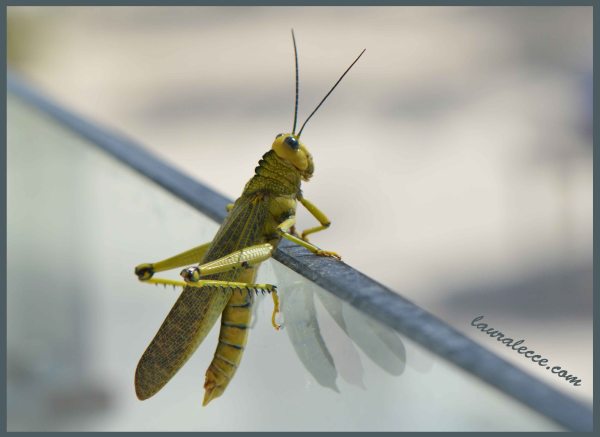
Blue Eyed Grasshopper - Photograph by Laura Lecce
Blue Eyed Grasshopper – Photograph by Laura Lecce

This past weekend I went to Mexico and had some amazing experiences that I will share with you next week. However, of all of my photographs, this one was quite unexpectedly the most beautiful (and I never thought I would say that about a giant grasshopper!). This almighty insect which visited my balcony was an incredible lime green color with striking blue eyes. It happily sat still while I took my time getting the photo just right. Later that same night as I was walking along the beach, I spotted a few more (even bigger ones!) which I almost stepped on in the dark. One of them was in the direct path of a crowd of people coming down the beach and in need of rescuing. I decided to carefully nudge the insect onto the book I was holding so that I could safely relocate it (mind you, the book was no bigger than the bug itself). However, rather than happily complying with my request, it instead took a flying leap onto my knee, and although I am not at all afraid of insects, this was still a most unpleasant surprise! After a successful second attempt, I moved the big guy out of harms way, and I’m sure he will make a very large and tasty breakfast for some bird in the morning.

Turtles always look sad

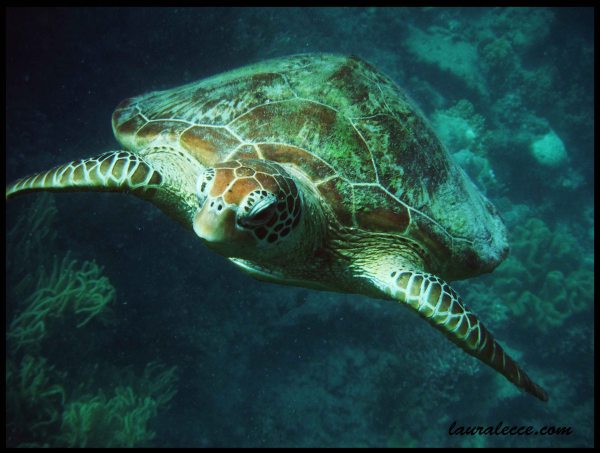
Sad Turtle - Photograph by Laura Lecce
Sad Turtle – Photograph by Laura Lecce

I can say that I have been a truly lucky human being to have had the opportunity to swim with sea turtles on quite a few occasions. This turtle was photographed while snorkeling at a beach on Fitzroy Island, a beautiful tropical paradise near Cairns (in Queensland, Australia). A lazy afternoon, just myself, my husband and several turtles… and we watched as they went about their daily munching on sea grasses.  To swim with these beautiful reptiles makes you appreciate how graceful they are at moving under the water, and they are quite content to have you swimming nearby. You’d think that for an animal which has outlived the dinosaurs, they should be happy, but instead they always look sad. Actually many of them are now listed on the endangered species list, which also makes me incredibly sad. I especially get upset when people think that rather than just observing wildlife, they interfere with it. I have seen this happen to turtles in Hawaii, where divers or snorkelers will grab onto them. This is NOT ok, and more respect should be given to these ancient and incredible creatures.

A snail, is a snail, is a snail…..Not.

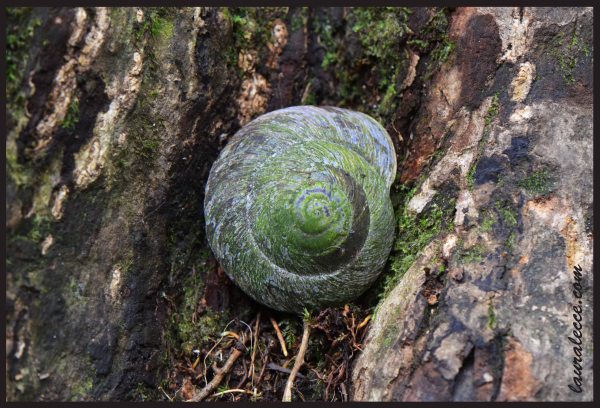
Puerto Rican Snail - Photograph by Laura Lecce
Puerto Rican Snail – Photograph by Laura Lecce

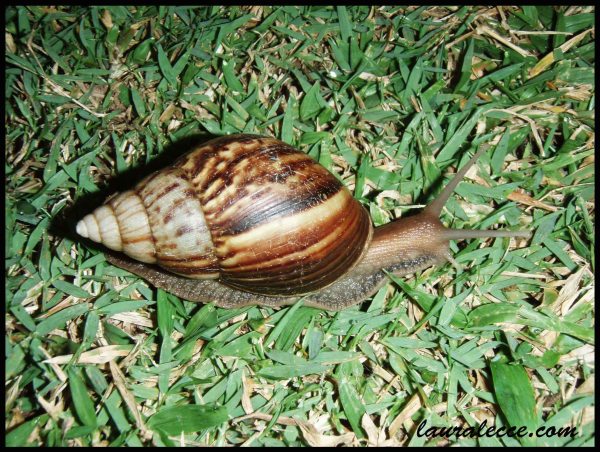
You know you were meant to be a biologist when you get excited to discover that snails from different parts of the world look different. Both Puerto Rican and Malaysian snails are the size of mammoths compared to snails found in Sydney backyards (hopefully this fact makes Sydney gardeners a little happier). However, the shell shapes of these slimy creatures is very different. The snails from Puerto Rico are quite flattened, with the center point of the spiral barely protruding at all (photo above). Malaysian snails have a very elongated shell with the spiral being very pointed (photo below). If you are unlucky enough to have lots of snails in your veggie patch in Sydney, you might one day be lucky enough to attract a blue tongue lizard to your yard. These stocky lizards will happily take care of your slimy infestation, which is reason enough for me to keep feeding the snails in the hope that a lizard one day comes to dinner.

Malaysian Snail – Photograph by Laura Lecce

Look At That Face!

The Cutest Pademelon - Photograph by Laura Lecce
The Cutest Pademelon – Photograph by Laura Lecce

Today is a pademelon photo purely for the cuteness factor. I just look at this furry, chubby little critter and want to cuddle it. Hopefully, this little cutie can bring a big smile to your face on what is likely a very ordinary Thursday (or at least it is for me).

If you’d like to read more about their fascinating reproductive biology, please click here.