
Swimming with whale sharks

Making Friends with the Fishes - Photograph by Ocean Tours
Making Friends with the Fishes – Photograph by Ocean Tours

This past trip to Mexico we made sure we went when the whale sharks are known to migrate to the warmer waters of the Mexican-Caribbean Sea, usually mid May to September. This photograph was taken by our guide from Ocean Tours, of my husband next to one of these gentle and giant whale sharks. Unfortunately I didn’t make it into many photos because every time I jumped into the water, I was immediately transfixed by the majestic creature in front of me, that I would forget to channel my inner Olympic swimmer to keep up with them! The bus-sized whale sharks were slowly cruising through the water, sucking up plankton without a care in sight, and even with their slow motions easily outswam us. I really enjoyed going on this tour because it felt like Mexican authorities really care about these mysterious beauties. There are many rules and regulations in place to make sure that people are not infringing on the whale sharks natural behaviors, feeding and migratory habits. They limit the season length, the number of boats, and allow only two people with a guide in the water with the shark at any time. They really want to make this a sustainable attraction, and I feel that many countries could use this as a great example that nature should be prioritized over fast monetary gain. Although I am not in any way a comfortable boat person, and after a while was “feeding the fishes” rather than swimming with them, I would recommend this fantastic experience to anyone.

Please click here to see my other underwater posts.
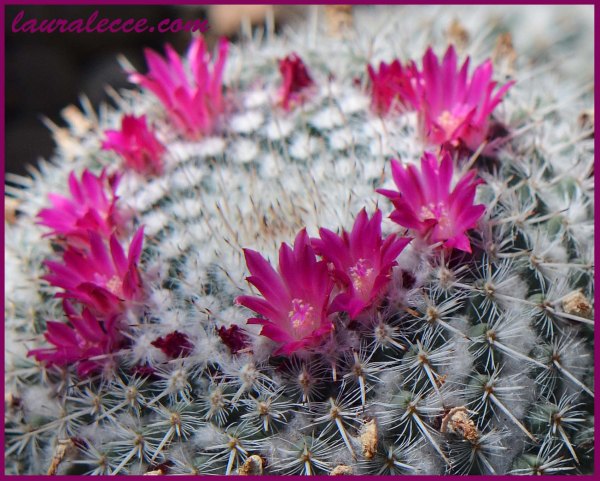
Friday Flower – Blooming Cactus

Cactus Flowers - Photograph by Laura Lecce
Cactus Flowers – Photograph by Laura Lecce

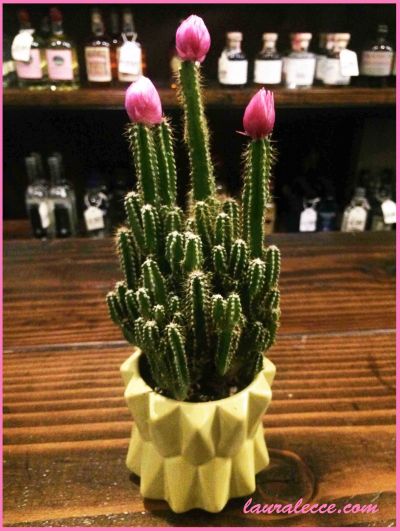
This photo was taken at the New York Botanical Gardens in the desert section of the Enid A. Haupt Conservatory. Cacti produce some of the most stunningly beautiful flowers in the world. These brilliantly colored pink flowers were on the top of a teeny little barrel-shaped cactus. A cactus must be mature to flower and this can take more than 30 years for some cacti, and 40-55 years for the saguaro cactus! A word of warning though, not all cactus flowers are real. I have seen flowering cacti becoming more popular at grocery stores and corner stores, and the same cactus comes in a variety of brightly colored flowers from purples and pinks to oranges and yellows. Wondering how this could be possible, I have felt the flowers to assure myself that they are real. They are technically “real” flowers, just not real cactus flowers. My friend recently purchased one, and was kind enough to provide me a photo (below). These flowers are actually a strawflower (or everlasting flower) which have been glued to the cactus. These flowers can stay in perfect condition long after removal from the plant, and for marketing convenience make a very pretty addition to a cactus.

In a perfect world - Photographed by a good friend
In a perfect world – Photographed by a good friend

Sloths – how will they ever keep up?

Happy to be Hanging Out - Photograph by Laura Lecce
Happy to be Hanging Out – Photograph by Laura Lecce

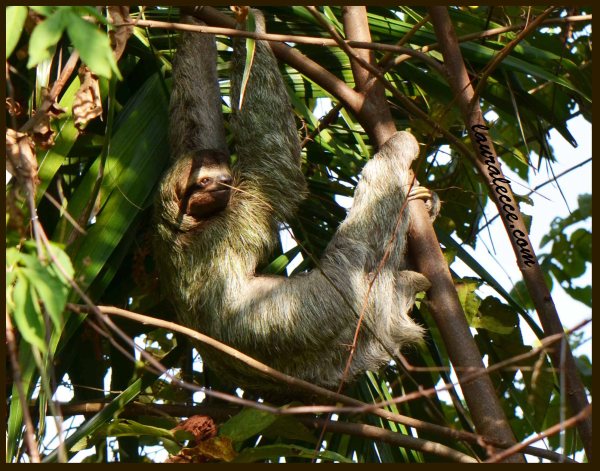
Last week on the 20th of November it was international sloth day. These incredibly interesting and bizarre creatures were a highlight on my visit to Costa Rica. Honestly, they are one of those creatures that you hope you will see, but in reality never think you will be lucky enough to actually spot one. I was so very wrong… we actually saw quite a few. We were also lucky enough to see a couple of them on the move (although they move frustratingly slow, making you wonder how they get anywhere they want). You can imagine that in a world where things move so fast, and increasingly so, that these animals may not have a place in the future without a lot of help from humans. However for now, they always have a smile on their face and are truly happy just hanging around. After spotting a few on our own we decided to go on a guided sloth spotting tour to learn more about these fascinating creatures. The two photographs below were taken on a mobile phone through a telescopic lens that our guide had, so I cannot take credit for them, but they clearly show the differences between the two families of sloths. The first is a three-toed sloth with a darker fur, and the second a two-toed sloth with lighter fur.

Three-Toed Sloth
Three-Toed Sloth
Two-Toed Sloth
Two-Toed Sloth

We were lucky to have photos with their heads in them, as they mostly sleep all day, and all you often get to see while looking up into the trees is a furry bum. Being Australian, I think of them as the Central/South American cousin of the Koala. Both move quite slowly, live high up in the trees, spend most of their day sleeping (about 15-20 hours a day) and for the few hours a day they are awake they munch on leaves.

Click here for other posts from Costa Rica.

Autumn Colors

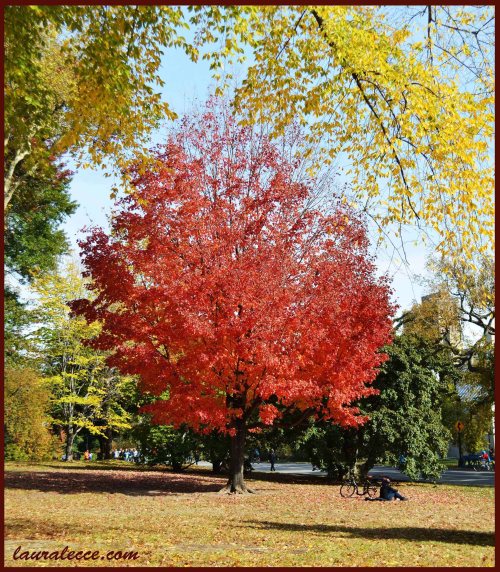
Autumn Colors - Photograph by Laura Lecce
Autumn Colors – Photograph by Laura Lecce

The Autumn season is upon us, and many trees in Manhattan are showing signs of changing color. Have you ever wondered how the trees know what season it is? Many trees and plants are photoperiodic, meaning they can detect the hours of darkness in a 24 hour period. In this way, trees and plants can detect the lengthening of nights into winter or shortening of nights heading into summer. This clever ability is achieved through pigments within the leaves called phytochromes, which can trigger a cascade of specific hormones and growth factors which regulate growth, flowering, and changes in leaf color during autumn. Leaves produce chlorophyll throughout most of the year, a green pigment critical for photosynthesis which allows trees and plants to absorb energy from light. Chlorophyll masks other pigments present within the leaf such as carotenes and xanthophyll, which are responsible for orange and yellow coloring, respectively. As the length of night increases during autumn, it triggers a cork-like membrane to form around the base of the leaf stalk called an abscission. The abscission slowly cuts off the supply of nutrients to the leaf, thus limiting the production of chlorophyll and allowing the orange and yellow colors to be visible. Anthocyanin is also produced in autumn, which gives leaves a red and purple coloring. Eventually nutrients to the leaves are completely halted causing the leaves to fall off. After accumulating a certain amount of time in the cold during winter months, which is referred to as the number of chill hours, trees can then respond to the increasingly warmer temperatures and shorter nights of Spring. During this time there is an upregulation of genes responsible for producing antioxidants and vitamin C to rid the tree of hydrogen peroxide which has built up during the winter dormancy. Trees are now able to produce the hormones and growth factors necessary to begin flowering and making new leaves again. Happy Autumn Everyone!

To see my other post on Autumn in New York, please click here.

Friday Flower – New England Aster

New England Aster - Photograph by Laura Lecce
New England Aster – Photograph by Laura Lecce

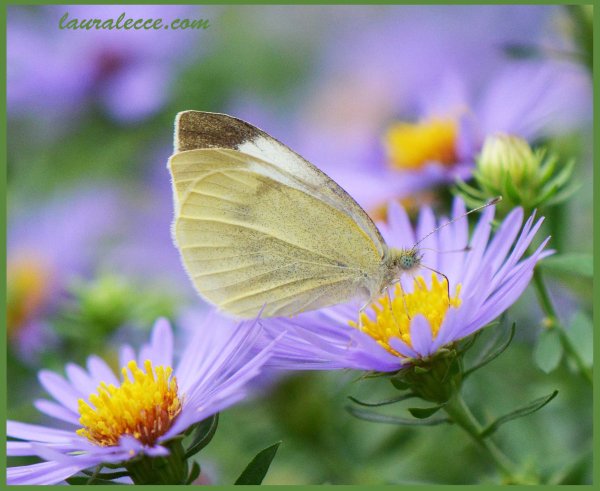
New England Aster is North American native plant, and is a great way of adding some bright color to your Autumn garden. Another fantastic perk is that these flowers are a great source of nectar for bees and butterflies, which can keep macro photographers busy for hours, and I also discovered that some butterflies have baby blue colored eyes. Not only are these flowers edible for insects, they are also a great way to add some color to your salads. This plant (mostly extract from the roots) has been used by many cultures (including Native Americans and Chinese) as a herbal remedy for fever, inflammation, and gut-related irritations. Planting some New England Aster is not only great for your garden, but can become so much more than just a pretty flower.

Red-Banded Leafhopper

Leafhopper - Photograph by Laura Lecce
Leafhopper – Photograph by Laura Lecce

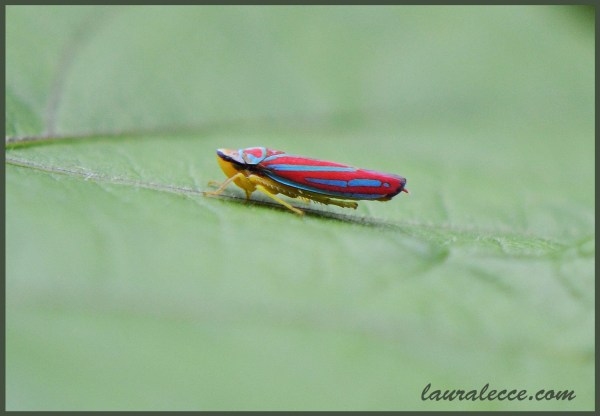
Gary I found one!!! Australia definitely doesn’t have such boldly colored leafhoppers, they are mostly a boring green color, making them very hard to spot amongst the leaves. In contrast, this red-banded leafhopper I found in Central Park is incredibly colorful, and doesn’t blend in at all. Native to North and Central America, this insect is so teeny tiny, it makes some ants look big! I wouldn’t have even known what I was looking at if it wasn’t for a post by Gary on his blog called krikitarts showcasing this spectacular insect (click here for post), with a fantastic photo as well. As soon as I spotted it, I was so excited to see one for myself. It was incredibly hard to photograph as the breeze kept moving the leaf, and the little critter wouldn’t stay still at all, and he’s so tiny I kept losing him, so this is as good a photo as I could get. This colorful insect certainly brightened up my overcast and dreary Sunday afternoon.

A lucky Lady

A Lucky Lady - Photograph by Laura Lecce
A Lucky Lady – Photograph by Laura Lecce

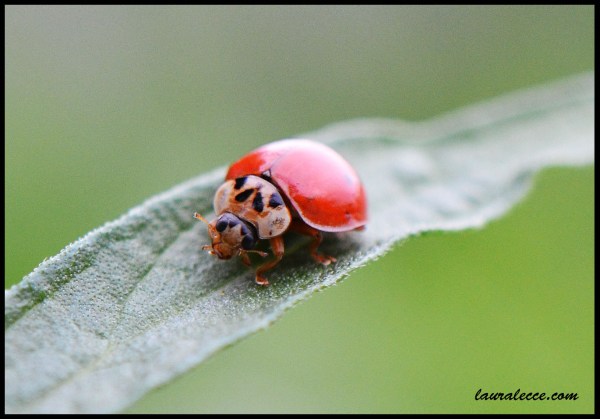
Life is supposedly based on a simple equation… Work hard and you will be successful. This may be somewhat true, but I believe that a whole heap of luck is also involved. There are many things you can do in life to increase your chances at being lucky – optimism, open mindedness and determination will go far in helping you live the life you consider successful, which of course, is very different for all of us. So today I offer you this lady beetle, which is considered a sign of good luck by many cultures. My grandmother strongly believes in luck, and would tape four-leaf clovers to all of the framed photos she had around the house. When I was a young child I would go hunting in the garden to find shiny red, yellow or orange lady beetles. After returning from the garden with one in my hand, my grandmother used to recite a nursery rhyme in Italian as she was tracing circles around the lady beetle on my palm. I no longer remember the words of the rhyme, but it was telling the lady beetle to fly away and find me a husband. As it turns out, a month after my husband and I started dating he went to Italy with his parents for 2 months. On his return he gifted me a necklace with a beautiful lady beetle charm attached, and 5 years on we were married. So, sometimes in life working hard doesn’t mean anything at all, you just need a little luck and a lady beetle.

Flower Friday – Skipper Butterfly on a Dahlia Bud

Skipper Butterfly - Photograph by Laura Lecce
Skipper Butterfly – Photograph by Laura Lecce

No science today, no facts, and no biology, just an adorable little butterfly on a plump dahlia bud. Why? Because todays post is dedicated to a very dear friend of mine. This post marks a moment in time when our friendship became greater than science. We will always find science in our lives because that is what we are trained to do, and biology will continue to exist around us. Friendships however, can sneak up on us gradually without any realization that it is happening, and will truly blossom when we face moments of hardship together. Together we will survive Winter and Spring will always follow.

Flower Friday – Japanese Toad Lily

Japanese Toad Lily - Photograph by Laura Lecce
Japanese Toad Lily – Photograph by Laura Lecce

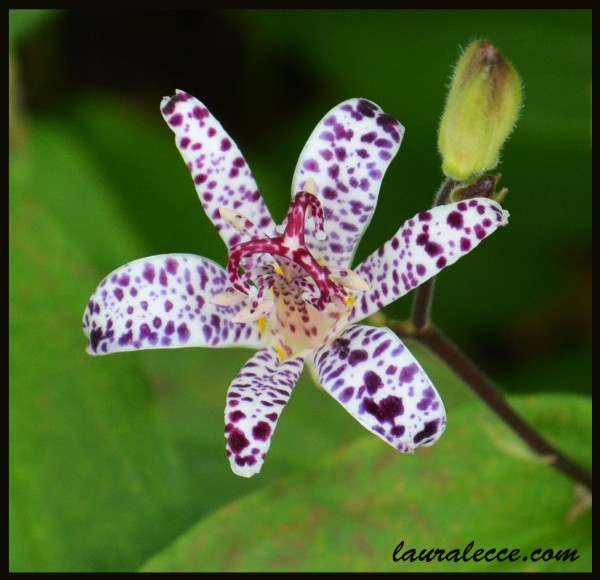
This is a photo of a Japanese Toad Lily, which in my opinion, is quite an unattractive name given to a beautiful flower. This was the first time I have seen or heard of this flower. It is native to Japan, and flowers late in summer to early fall. One particular piece of information that stuck in my mind above all others, is that this flower is deer resistant. To an Australian who has never, and will never experience a deer visiting my garden, this intrigued me. I further found out that deer resistant means that it is not one of their favorite flowers to munch on. If I had the slightest possibility that a deer might visit me, I would be someone who would plant flowers purely to entice deer into my garden. Though I can also understand the frustration of people who want a flower filled garden, and are constantly losing flowers to hungry deer. If you are experiencing that frustration, then supposedly this flower is a good choice for your garden, as it may last longer than other flowers which deer think are yummy to eat.

Have a great weekend everyone, and for other flowers please click here.