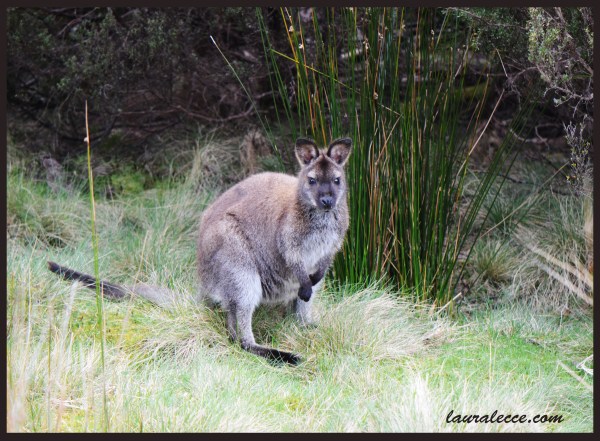
This gorgeous wallaby was photographed in Tasmania, Australia. Native to Australia, these beautiful animals are in the same family as Kangaroos but were informally designated as wallabies due to their generally smaller size. Interestingly, there are a number of feral populations of wallabies in various places around the world including Hawaii, England and France because these bouncy critters are great at escaping from the zoo!
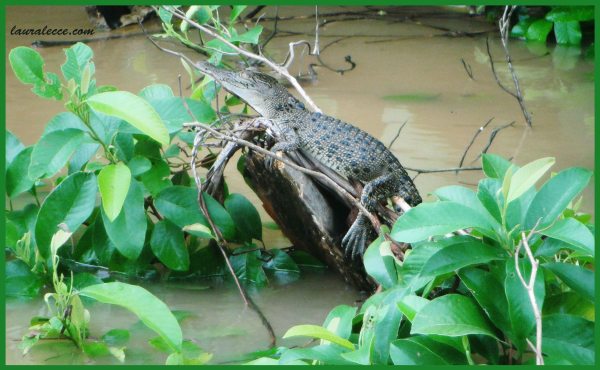
Even the largest and scariest of animals were once a cute little baby (except birds which definitely get cuter with age). This adorable baby crocodile is contently sunning itself in a river in Cairns, located in far north Queensland. As cute as this little guy may be, where there is a baby, there must be a mummy and a daddy. Cairns is home to saltwater crocodiles, currently the largest living reptiles, and the much larger and more aggressive cousin of the freshwater crocs. It made me very glad that I was in a boat on this river and not in a small canoe!
This small coral structure looks like a beautiful underwater castle. It is a hard coral which is home to millions of teeny tiny individual polyps in a castle constructed out of calcium carbonate. Other likely residents within this castle are single-celled algae. The algae use energy from the sun to make sugars and fats which they share with the coral allowing it to grow faster. The coral animals also make waste which feeds the algae. Together they make a very large and happy family of teeny residents in a beautiful castle. They even have a blue Christmas tree worm as a pet in the yard!
It takes time to be old and wise – Photograph by Laura Lecce
I was lucky enough to encounter many Capuchin monkeys in Costa Rica. After watching them for some time, I was able to observe some of their relationships and behaviors. In the first image, I had clearly met one of the more senior and respected members of the group. This individual was happiest observing the humans that were observing him, and was quite content in sitting back and allowing the other younger capuchins to cause a raucous.
The Coast is Clear – Photograph by Laura Lecce
They often moved together as large family groups, and when they did it was like a tornado moving through the trees. At one point they needed to cross a road, and before letting the mums and bubs exit the safety of the trees, they sent out scouts (pictured in the second image) to make sure the coast was clear. Once the scouts gave the all clear, monkey after monkey came flying out of the trees to scurry across the road and back into the jungle. Some of their leaps from tree to tree were incredibly far and seemed very dangerous, but they were completely confident and surefooted.
Caught Making a Mess – Photograph by Laura Lecce
The monkey pictured in this last photo was caught making quite a mess with the little fruits hanging from this palm tree. Surely a source of food for these cuties, but at times it looked like it was having more fun throwing the fruits to the ground than actually caring to eat them. I think their cute little faces easily fool humans into thinking they are very friendly, but in contrary they can be quite aggressive and territorial and wont hesitate to flash some pretty sharp canines if you get too close.
I recently took a photo of this moth, plainly colored in tan, black and white. I found the geometric pattern on its wings quite strikingly symmetrical and streamlined that it reminded me of a fighter jet airplane. A very large and very beautiful winged creature.
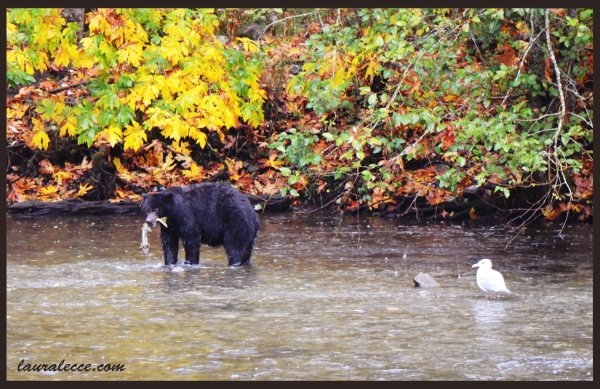
Bear and the Hungry Bird – Photograph by Laura Lecce
It has been a life long dream of mine to see big fluffy bears in the wild. This may be due to the fact that Australia has absolutely no large mammalian predators (our biggest is the dingo, which is basically a gorgeous golden colored dog, we do however win with the scary reptiles). So I went to Canada during the season where bears are hunting salmon in the streams to fatten up before winter hibernation. It was truly a National Geographic experience. I went to a salmon hatchery on Vancouver Island which is known to attract the local bears.
Bears Hunting – Photograph by Laura Lecce
I was able to watch the bears for hours, who were thankfully much more interested in the salmon than the tourists on the edge of the stream! They were so spoilt for food that they barely ate much of the fish before discarding the half eaten carcass, much to the delight of the nearby birds. It was a magical experience to be in the presence of such large and spectacular creatures such as these.
This is a dog we met while on a road trip in Costa Rica. Seeing a chocolate brown dog in front of an aqua colored wall, I just had to stop for a photo. There was only one way to describe the look on this dog’s face as he saw us pull up – utterly unimpressed. He was like a grumpy old man sitting on his porch wondering why the hell these damn tourists had to come to his country to pester him by taking his photo. In the end, no matter how much he looked like he hated me, I still love him!
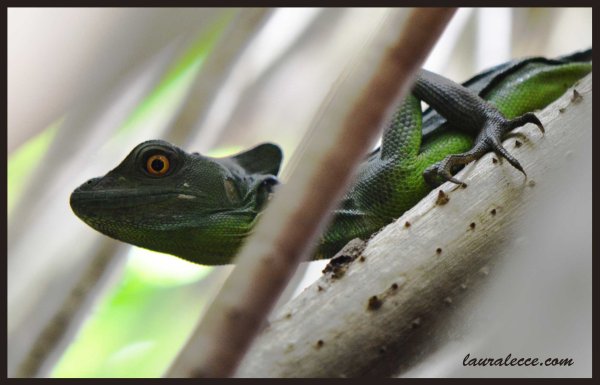
I believe that what I have photographed here is a green basilisk lizard, commonly found on the Atlantic side of Costa Rica. The adult males have three crests, one on the head, back and tail (which makes them look like a mini dinosaur). Adult females only have one on the head, and juveniles don’t have any. Despite growing quite large (up to 3 feet long head to tail), they are a skittish lizard, but this particular green beauty was quite comfortable hiding deep in the protection of these tree roots. Unfortunately for me, it made for some pretty uncomfortable and awkward photography half sitting/lying in some bushes and rocks on the edge of a steamy hot spring in my bikini. I think some of the other tourists thought I was a mad person photographing tree roots! Anyway, these lizards are also called Jesus Christ lizards for their ability to run across water, usually when spooked by a predator. Knowing that this is their best method of escape, they are often found in trees along the edges of a body of water. They are also great swimmers and can reportedly spend up to 30 minutes underwater. Click here for a very cool slow motion video by National Geographic of the Jesus Christ lizard running across water. Enjoy!
Rhinoceros beetles are the largest of all beetles, and in far north Queensland can grow up to 2.5inches (about 6cms). I’d like to think that this beautiful male rhinoceros beetle who lives in Cairns is playing hide and seek with his lady friend inside the coconut. However, it might be that he is actually having a territorial dispute with another male over this lovely coconut house. The beetle in the coconut was also playing hide and seek with me, so I didn’t get a good look to see if it had horns or not (which only males have and are used to fight off other males over the privilege to mate with a female). Judging by the thick armor and huge horns, I get the feeling though that male beetles just don’t know how to be friendly at all.
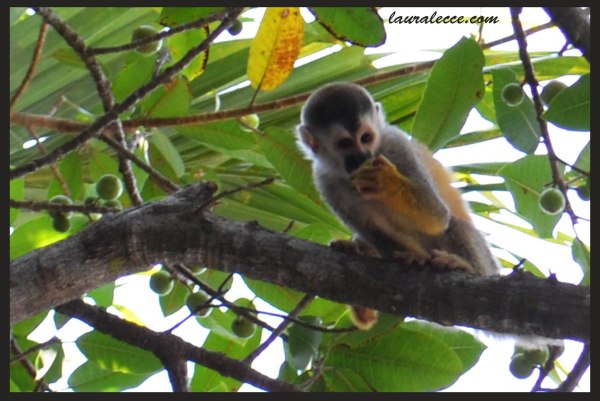
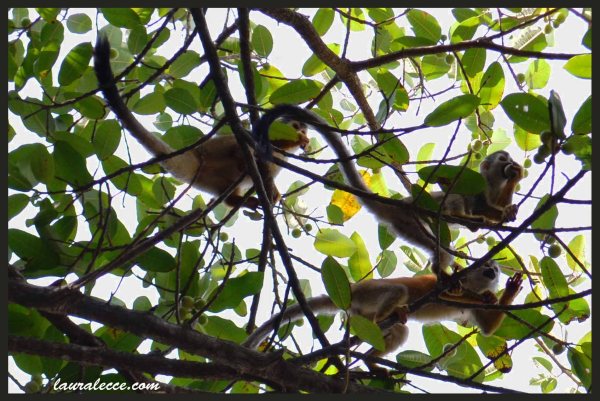
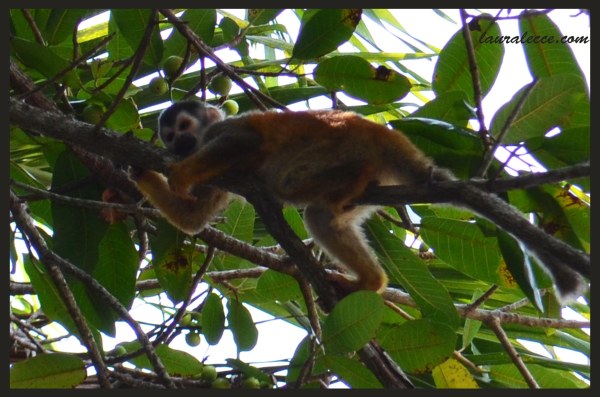
This year is Chinese zodiac year of the Monkey, and it certainly is for me. I have just spent a week with various monkeys in the jungles of Costa Rica. Of all of them, this is definitely my favorite. The Squirrel Monkey. Adorable little creatures flitting through the trees like a family of small, grey and orange birds. You can hear them calling to each other as they bounce around, the sound of content and happy chirpings. Being somewhat cheeky like most monkey can be, they swept through this tree eating the fruits, only taking a few bites of each one before throwing them to the ground. Sometimes I think they were even purposefully aiming at my head. However, I will gladly take a few fruits to the head to spend time with these cute and cheeky little monkeys.
Squirrel Monkeys – Photograph by Laura LecceTired Monkey – Photograph by Laura Lecce





 Laura Lecce's art and photography