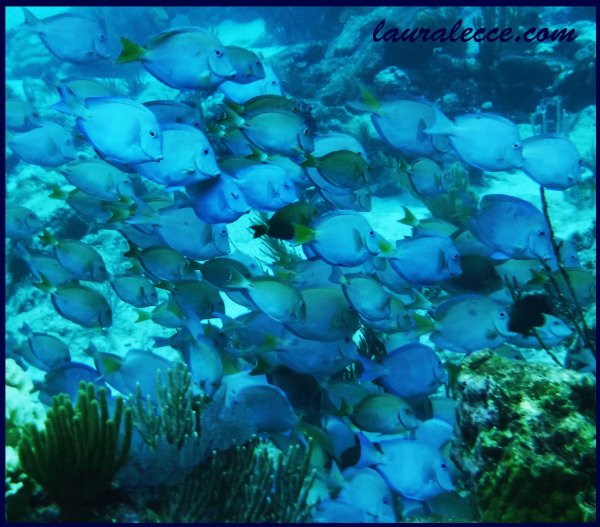
A gorgeous school of Blue Tang fish swimming through the corals around South Water Caye island in Belize. These fish swim across you in undulating waves, and it’s very soothing and relaxing to watch them. They mostly swim in a large school of fish, moving through the water as if they are a single large organism, all connected and communicating. They seem so peaceful, as if no predators exist in the world, and for those moments I wish that could be true for us all.
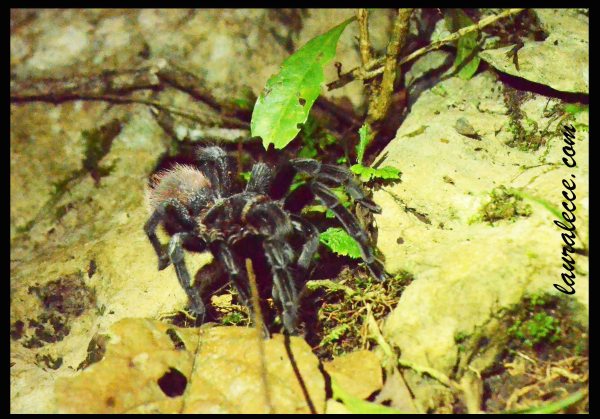
Even though I named this photo terrifying, and I can understand why it might be to some people, I was so excited to see this gorgeously hairy tarantula. Even though tarantulas have fangs and are venomous, and may on a rare occasion bite causing discomfort, there has never been a death by tarantula bite (of a human). Their body hairs however can irritate the skin and cause a rash, and some people are known to be highly allergic to them. These spiders hunt at night which is when we saw this beauty, which was about the size of my hand. Squished up in a burrow they wait for unsuspecting prey (or a thin stick in this case) to walk by the entrance to their lair, and then they pounce! As is quite common in the world of spiders, male spiders are terrified of females, but of course need to get close to mate. So to make it a quicker affair, before males encounter a female they lay a ‘sperm-web’ and secrete semen onto it, rub their specialized legs into it (pedipalps), and then go on a search for a receptive female. Using female pheromones to guide him, he finally encounters a female burrow, and will tap to let her know he is there. If she likes him she will exit the burrow and he will spider-dance for her. If he has impressed her, her will get closer, hold her fangs with his legs and deposit the sperm underneath her abdomen. If she didn’t enjoy his dance she will either pay him no attention at all or attack him, and hopefully he has fast enough reflexes to get away.
To my absolute delight, the moment I arrived on the small island of South Water Caye in Belize, I spotted an osprey nest. I had previously stalked out osprey nests (each with a baby inside) in Yellowstone National Park hoping to get a glimpse of a parent returning, but having no luck at all. This time, the ospreys and I were stranded on an island together and I was determined to get my photograph… and I got several! These large beautiful birds mate for life, and I got to watch a gorgeous couple of ospreys ‘baby making’ on several occasions. I don’t think it would be very pleasant at all having your male partner dive onto your back with huge sharp talons, I hope the feathers provide some cushioning. Ospreys live near water, either a river or the ocean where it can hunt for fish, so you may get to see some dive bombing. They inhabit all continents on earth except Antarctica, which means they are in Australia too!
After returning recently from an epic trip to Belize, I will start off with my favorite animal. This glorious and giant iguana who was longer than I am tall, was perched high up in a palm tree, enjoying the view of the ocean on the coast of Belize. I have so much love for these beautiful, dinosaur-like reptiles, but sadly they never return my love. Instead I always get a stony glare, and this one went so far as to wag his chin flap at me to show me just how annoyed he was that I was taking his photograph. This action of disdain, to his disappointment, only made me love him even more!
Yellowstone National Park is full of breathtaking scenery. You can drive from wildflower covered hills and grass covered valleys, to snow-scattered mountains such as the ones in this photo. I had to be prepared for significant changes in temperature along this trip, ready for just about anything. I often find myself pointing my camera at a dead tree as the focal point of my photo. There is something hauntingly beautiful about a naked tree, the branches reaching out and forming interesting shapes. No longer a living part of this world but a significant aspect of the current landscape in which it once lived.
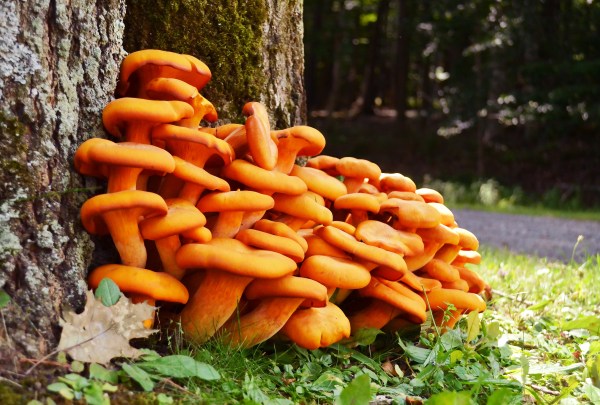
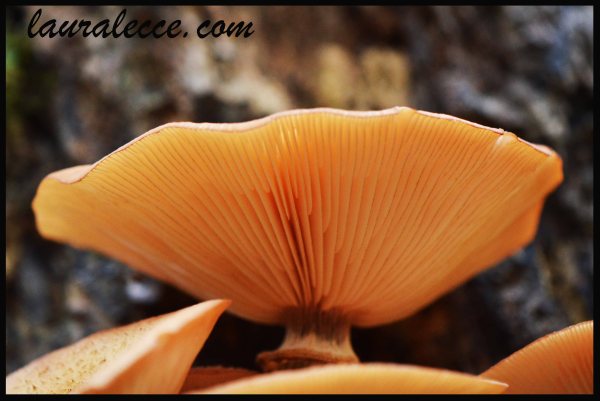
A Mound of Magnificent Mushrooms – Photograph by Laura Lecce
This giant family of mushrooms photographed in Rochester NY, have prospered by setting themselves up in this ideal location. Nestled at the foot of this tree, on the shady side of town, where they don’t have to deal with any hot sun. Even so, each mushroom still fights for it’s fair share of light by either climbing higher or further out than its relatives. They get their nutrients from whatever leaf litter that falls from the tree and degrades into the rich soil below. They will each make millions of microscopic spores in the gills hidden underneath their caps, and eventually release them into the wind to find a new home next year.
By that I mean my comfort! This chipmunk was way too curious for my liking and I was worried he was going to jump on my head! He kept getting so close my camera couldn’t focus and I had to keep backing up to take a photo. As a general rule I prefer not to interact with wildlife so that I can photograph them behaving naturally in their environment, but sometimes wildlife can’t help but get a little too curious!
This picture perfect fungi was spotted while hiking in Quebec. I am always on the lookout for a beautiful mushroom to photograph, which usually results in me lying on the ground with my camera, this one however was on the side of a tree. I have yet to see a cartoon-style red toadstool with white spots which are common in the UK, but hopefully one day. Fungi are a fascinating group of living organisms which behave differently to plants. They begin from a tiny microscopic spore which needs nutrient rich soil to grow, as it cannot make energy from chlorophyll like plants. Unlike plants and animals which use mostly cell division to grow, a slow and energy consuming process, mushrooms grow quite fast. Their ability to grow fast is because their cells balloon in size by drawing in large amounts of liquid, and is also why mushrooms need to grow in wet and humid areas. They are essentially a water balloon of about 90% water, and can be easily dehydrated and rehydrated for storing and cooking. Needless to say not all mushrooms are safe to eat, so never touch or eat wild mushrooms unless you know for sure that it is a safe kind of mushroom to eat.
I did not see these Canadian geese in Canada but in Yellowstone National Park. It seems the name is misleading as I have seen a lot of these geese in the US! They even nest in Central Park in Manhattan, and in the Spring you will see chicken-sized, fluffy babies following their parents around. These two posed so perfectly that they deserved to have their photo taken.
For other posts from Yellowstone National Park, please click here. This post is dedicated to my Canadian friends.
I certainly didn’t grow up with Autumn colors like this in Sydney, which is why I am in such awe when I get the chance to see them now. Acadia National Park was the perfect destination for a weekend getaway to see peak foliage colors painted across the most stunning scenery. This glorious day was the ideal combination of warm golden sun and chilly air – the best hiking weather. Climbing the steep Beehive Trail to the top of this small mountain provided an incredible vantage point with which to admire Mother Nature’s artwork. As a person who lives for color, even I could not have imagined that this many brilliant and intense colors could exist in a single landscape. Just incredible!





 Laura Lecce's art and photography